Subadditivity
Property of some mathematical functions
In mathematics, subadditivity is a property of a function that states, roughly, that evaluating the function for the sum of two elements of the domain always returns something less than or equal to the sum of the function's values at each element. There are numerous examples of subadditive functions in various areas of mathematics, particularly norms and square roots. Additive maps are special cases of subadditive functions.
01Definitions
A subadditive function is a function 

An example is the square root function, having the non-negative real numbers as domain and codomain:
since 

A sequence 

Note that while a concave sequence is subadditive, the converse is false. For example, arbitrarily assign 
![[0.5,1]](https://wikimedia.org/api/rest_v1/media/math/render/svg/28b12b2e130f0013fb23a77854afeb5dafbc0d48)
02Properties
Sequences
A useful result pertaining to subadditive sequences is Fekete's lemma.
Fekete's Subadditive Lemma, For every subadditive sequence 


Let 
By definition, 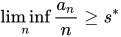
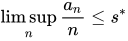
If not, then there exists a subsequence 

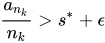

Since 

By infinitary pigeonhole principle, there exists a sub-subsequence of 

In more detail, by subadditivity, we have

which implies 
The analogue of Fekete's lemma holds for superadditive sequences as well, that is:


There are extensions of Fekete's lemma that do not require the inequality

Continue the proof as before, until we have just used the infinite pigeonhole principle.
Consider the sequence 



By the assumption, for any 
![\ln(s+t)\in [\ln(1.5s),\ln(3s)]=\ln s+[\ln 1.5,\ln 3]](https://wikimedia.org/api/rest_v1/media/math/render/svg/f39693ff88222dceaad72c9b56379bb43f368862)
If we were dealing with continuous variables, then we can use subadditivity to go from 
![a_{n_{k}}+[\ln 1.5,\ln 3]](https://wikimedia.org/api/rest_v1/media/math/render/svg/9e694b438477d2efac7f2e96c224e7712e9b74dd)
![a_{n_{k}}+\ln 1.5+[\ln 1.5,\ln 3]](https://wikimedia.org/api/rest_v1/media/math/render/svg/e7557cd5c9491ef07efba012e24b5734f8c212c8)

Though we don't have continuous variables, we can still cover enough integers to complete the proof. Let 


![(n_{k}+m\mathbb {Z} )\cap (\ln n_{k}+[\ln(1.5),\ln(3)])](https://wikimedia.org/api/rest_v1/media/math/render/svg/b71f2a2ebc0cb6d5d94d0ba27e9d5c3a0f0af8b3)
![\ln n_{k}+[\ln(1.5),\ln(3)]](https://wikimedia.org/api/rest_v1/media/math/render/svg/d8b627c2f2c0551f71e4ac1c1d59f8fc102c5efa)
![\ln n'+[\ln(1.5),\ln(3)]](https://wikimedia.org/api/rest_v1/media/math/render/svg/55ffa2d15772c185d8ad3902ca2c772216a6d905)
![(n_{k}+m\mathbb {Z} )\cap (\ln n_{k}+[\ln(1.5),\infty ])](https://wikimedia.org/api/rest_v1/media/math/render/svg/973ac3fc2f9cf743a0a70e6252e0cea80913d92a)
With that, all 
Moreover, the condition 


There are also results that allow one to deduce the rate of convergence to the limit whose existence is stated in Fekete's lemma if some kind of both superadditivity and subadditivity is present.
Additionally, analogues of Fekete's lemma have been proven for subadditive real maps (with additional assumptions) from finite subsets of an amenable group, and further, of a cancellative left-amenable semigroup.
Functions
Theorem:, For every measurable subadditive function 


If f is a subadditive function, and if 0 is in its domain, then f(0) ≥ 0. To see this, take the inequality at the top. 

A concave function 




The negative of a subadditive function is superadditive.
03Examples in various domains
Entropy
Entropy plays a fundamental role in information theory and statistical physics, as well as in quantum mechanics in a generalized formulation due to von Neumann. Entropy appears always as a subadditive quantity in all of its formulations, meaning the entropy of a supersystem or a set union of random variables is always less or equal than the sum of the entropies of its individual components. Additionally, entropy in physics satisfies several more strict inequalities such as the Strong Subadditivity of Entropy in classical statistical mechanics and its quantum analog.
Economics
Subadditivity is an essential property of some particular cost functions. It is, generally, a necessary and sufficient condition for the verification of a natural monopoly. It implies that production from only one firm is socially less expensive (in terms of average costs) than production of a fraction of the original quantity by an equal number of firms.
Economies of scale are represented by subadditive average cost functions.
Except in the case of complementary goods, the price of goods (as a function of quantity) must be subadditive. Otherwise, if the sum of the cost of two items is cheaper than the cost of the bundle of two of them together, then nobody would ever buy the bundle, effectively causing the price of the bundle to "become" the sum of the prices of the two separate items. Thus proving that it is not a sufficient condition for a natural monopoly; since the unit of exchange may not be the actual cost of an item. This situation is familiar to everyone in the political arena where some minority asserts that the loss of some particular freedom at some particular level of government means that many governments are better; whereas the majority assert that there is some other correct unit of cost.
Finance
Subadditivity is one of the desirable properties of coherent risk measures in risk management. The economic intuition behind risk measure subadditivity is that a portfolio risk exposure should, at worst, simply equal the sum of the risk exposures of the individual positions that compose the portfolio. The lack of subadditivity is one of the main critiques of VaR models which do not rely on the assumption of normality of risk factors. The Gaussian VaR ensures subadditivity: for example, the Gaussian VaR of a two unitary long positions portfolio 





![\rho _{xy}\in [-1,1]](https://wikimedia.org/api/rest_v1/media/math/render/svg/353fbcfa41e02d7429827c6c90d393321cb4d9ba)

Thermodynamics
Subadditivity occurs in the thermodynamic properties of non-ideal solutions and mixtures like the excess molar volume and heat of mixing or excess enthalpy.
Combinatorics on words
A factorial language 




For every 


Sources and credits
This article is adapted from the Wikipedia article “Subadditivity”, written by its contributors and licensed under CC BY-SA 4.0. Fathomly has changed the layout, removed citation markers, navigation and maintenance notices, and adjusted punctuation. This adapted version is shared under the same license. For references, see the original article.
Fathomly is not affiliated with or endorsed by the Wikimedia Foundation. Spotted a problem? Tell us.