Studentized range distribution

In probability and statistics, studentized range distribution is the continuous probability distribution of the studentized range of an i.i.d. sample from a normally distributed population.
Suppose that we take a sample of size n from each of k populations with the same normal distribution N(μ, σ2) and suppose that 

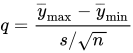
01Definition
Probability density function
Differentiating the cumulative distribution function with respect to q gives the probability density function.
![f_{\text{R}}(q;k,\nu )={\frac {{\sqrt {2\pi \,}}\,k\,(k-1)\,\nu ^{\nu /2}}{\Gamma (\nu /2)\,2^{\left(\nu /2-1\right)}}}\int _{0}^{\infty }s^{\nu }\,\varphi ({\sqrt {\nu \,}}\,s)\,\left[\int _{-\infty }^{\infty }\varphi (z+q\,s)\,\varphi (z)\,\left[\Phi (z+q\,s)-\Phi (z)\right]^{k-2}\,\mathrm {d} z\right]\,\mathrm {d} s](https://wikimedia.org/api/rest_v1/media/math/render/svg/20b454e7c3be46bad6a6b685406779af6e53aad8)
Note that in the outer part of the integral, the equation

was used to replace an exponential factor.
Cumulative distribution function
The cumulative distribution function is given by
![F_{\text{R}}(q;k,\nu )={\frac {{\sqrt {2\pi \,}}\,k\,\nu ^{\nu /2}}{\,\Gamma (\nu /2)\,2^{(\nu /2-1)}\,}}\int _{0}^{\infty }s^{\nu -1}\varphi ({\sqrt {\nu \,}}\,s)\left[\int _{-\infty }^{\infty }\varphi (z)\left[\Phi (z+q\,s)-\Phi (z)\right]^{k-1}\,\mathrm {d} z\right]\,\mathrm {d} s](https://wikimedia.org/api/rest_v1/media/math/render/svg/c21803c454533585edeaa35d2b23061da152de3f)
Special cases
If k is 2 or 3, the studentized range probability distribution function can be directly evaluated, where 


![f_{R}(q;k=3)=6{\sqrt {2\,}}\,\varphi \left(\,q/{\sqrt {2\,}}\right)\left[\Phi \left(q/{\sqrt {6\,}}\right)-{\tfrac {1}{2}}\right]](https://wikimedia.org/api/rest_v1/media/math/render/svg/492f3d60fda45450ff9e9a619b855bb61fb1f5f1)
When the degrees of freedom approaches infinity the studentized range cumulative distribution can be calculated for any k using the standard normal distribution.
![F_{R}(q;k)=k\,\int _{-\infty }^{\infty }\varphi (z)\,{\Bigl [}\Phi (z+q)-\Phi (z){\Bigr ]}^{k-1}\,\mathrm {d} z=k\,\int _{-\infty }^{\infty }\,{\Bigl [}\Phi (z+q)-\Phi (z){\Bigr ]}^{k-1}\,\mathrm {d} \Phi (z)](https://wikimedia.org/api/rest_v1/media/math/render/svg/f380dc1c42ad0123fbaf0159324121161c99fec0)
02Applications
Critical values of the studentized range distribution are used in Tukey's range test.
The studentized range is used to calculate significance levels for results obtained by data mining, where one selectively seeks extreme differences in sample data, rather than only sampling randomly.
The Studentized range distribution has applications to hypothesis testing and multiple comparisons procedures. For example, Tukey's range test and Duncan's new multiple range test (MRT), in which the sample x1, ..., xn is a sample of means and q is the basic test-statistic, can be used as post-hoc analysis to test between which two groups means there is a significant difference (pairwise comparisons) after rejecting the null hypothesis that all groups are from the same population (i.e. all means are equal) by the standard analysis of variance.
04Derivation
The studentized range distribution function arises from re-scaling the sample range R by the sample standard deviation s, since the studentized range is customarily tabulated in units of standard deviations, with the variable q = R⁄s . The derivation begins with a perfectly general form of the distribution function of the sample range, which applies to any sample data distribution.
In order to obtain the distribution in terms of the "studentized" range q, we will change variable from R to s and q. Assuming the sample data is normally distributed, the standard deviation s will be χ distributed. By further integrating over s we can remove s as a parameter and obtain the re-scaled distribution in terms of q alone.
General form
For any probability density function fX, the range probability density fR is:
![f_{R}(r;k)=k\,(k-1)\int _{-\infty }^{\infty }f_{X}\left(t+{\tfrac {1}{2}}r\right)f_{X}\left(t-{\tfrac {1}{2}}r\right)\left[\int _{t-{\tfrac {1}{2}}r}^{t+{\tfrac {1}{2}}r}f_{X}(x)\,\mathrm {d} x\right]^{k-2}\,\mathrm {d} \,t](https://wikimedia.org/api/rest_v1/media/math/render/svg/462ed05fb46aaf8cae430562c3f64d5c1e0d06a7)
What this means is that we are adding up the probabilities that, given k draws from a distribution, two of them differ by r, and the remaining k − 2 draws all fall between the two extreme values.
If we change variables to u where 
![f_{R}(r;k)=k\,(k-1)\int _{-\infty }^{\infty }f_{X}(u+r)\,f_{X}(u)\,\left[\,F_{X}(u+r)-F_{X}(u)\,\right]^{k-2}\,\mathrm {d} \,u](https://wikimedia.org/api/rest_v1/media/math/render/svg/f87b66f2887c8ba73d449fe77097473b9bffeb25)
We introduce a similar integral, and notice that differentiating under the integral-sign gives
![{\begin{aligned}{\frac {\partial }{\partial r}}&\left[k\,\int _{-\infty }^{\infty }f_{X}(u)\,{\Bigl [}\,F_{X}(u+r)-F_{X}(u)\,{\Bigr ]}^{k-1}\,\mathrm {d} \,u\right]\\[5pt]={}&k\,(k-1)\int _{-\infty }^{\infty }f_{X}(u+r)\,f_{X}(u)\,{\Bigl [}\,F_{X}(u+r)-F_{X}(u)\,{\Bigr ]}^{k-2}\,\mathrm {d} \,u\end{aligned}}](https://wikimedia.org/api/rest_v1/media/math/render/svg/79ce11373630f6a4a3d2e1d4b738219af75b9388)
which recovers the integral above, so that last relation confirms
![{\begin{aligned}F_{R}(r;k)&=k\int _{-\infty }^{\infty }f_{X}(u){\Bigl [}\,F_{X}(u+r)-F_{X}(u)\,{\Bigr ]}^{k-1}\,\mathrm {d} \,u\\&=k\int _{-\infty }^{\infty }{\Bigl [}\,F_{X}(u+r)-F_{X}(u)\,{\Bigr ]}^{k-1}\,\mathrm {d} \,F_{X}(u)\end{aligned}}](https://wikimedia.org/api/rest_v1/media/math/render/svg/c5194b7fd58dd44d6e6c4929e2f2e6387e481c29)
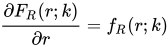
because for any continuous cdf
Special form for normal data
The range distribution is most often used for confidence intervals around sample averages, which are asymptotically normally distributed by the central limit theorem.
In order to create the studentized range distribution for normal data, we first switch from the generic fX and FX to the distribution functions φ and Φ for the standard normal distribution, and change the variable r to s·q, where q is a fixed factor that re-scales r by scaling factor s:
![f_{R}(q;k)=s\,k\,(k-1)\int _{-\infty }^{\infty }\varphi (u+sq)\varphi (u)\,\left[\,\Phi (u+sq)-\Phi (u)\right]^{k-2}\,\mathrm {d} u](https://wikimedia.org/api/rest_v1/media/math/render/svg/0f9533dfe9031ad819e3339f0d818cdf94cd4655)
Choose the scaling factor s to be the sample standard deviation, so that q becomes the number of standard deviations wide that the range is. For normal data s is chi distributed and the distribution function fS of the chi distribution is given by:
![f_{S}(s;\nu )\,\mathrm {d} s={\begin{cases}{\dfrac {\nu ^{\nu /2}\,s^{\nu -1}e^{-\nu \,s^{2}/2}\,}{2^{\left(\nu /2-1\right)}\Gamma (\nu /2)}}\,\mathrm {d} s&{\text{for }}\,0<s<\infty ,\\[4pt]0&{\text{otherwise}}.\end{cases}}](https://wikimedia.org/api/rest_v1/media/math/render/svg/bc1a8ce22925692c9ab3ea76b180775656bcd99e)
Multiplying the distributions fR and fS and integrating to remove the dependence on the standard deviation s gives the studentized range distribution function for normal data:
![f_{R}(q;k,\nu )={\frac {\nu ^{\nu /2}\,k\,(k-1)}{2^{\left(\nu /2-1\right)}\Gamma (\nu /2)}}\int _{0}^{\infty }s^{\nu }e^{-\nu s^{2}/2}\int _{-\infty }^{\infty }\varphi (u+sq)\,\varphi (u)\,\left[\,\Phi (u+sq)-\Phi (u)\right]^{k-2}\,\mathrm {d} u\,\mathrm {d} s](https://wikimedia.org/api/rest_v1/media/math/render/svg/13c262ebcd5ba753289f769a9460f66ab945c75d)
where
- q is the width of the data range measured in standard deviations,
- ν is the number of degrees of freedom for determining the sample standard deviation, and
- k is the number of separate averages that form the points within the range.
The equation for the pdf shown in the sections above comes from using

to replace the exponential expression in the outer integral.
Sources and credits
This article is adapted from the Wikipedia article “Studentized range distribution”, written by its contributors and licensed under CC BY-SA 4.0. Fathomly has changed the layout, removed citation markers, navigation and maintenance notices, and adjusted punctuation. This adapted version is shared under the same license. For references, see the original article.
Images, from Wikimedia Commons:
- StudentizedRangePDF.svg by Shiyu Ji, CC BY-SA 4.0
Fathomly is not affiliated with or endorsed by the Wikimedia Foundation. Spotted a problem? Tell us.