Reference articles on history, science, culture and more
Encyclopedia

Strict-feedback form

In control theory, dynamical systems are in strict-feedback form when they can be expressed as
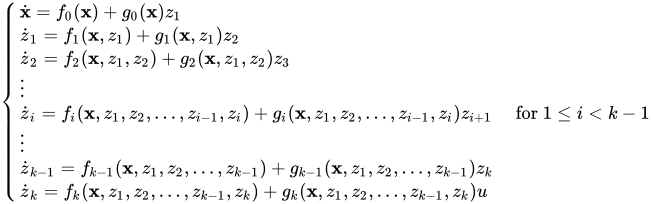
{\begin{cases}{\dot {\mathbf {x} }}=f_{0}(\mathbf {x} )+g_{0}(\mathbf {x} )z_{1}\\{\dot {z}}_{1}=f_{1}(\mathbf {x} ,z_{1})+g_{1}(\mathbf {x} ,z_{1})z_{2}\\{\dot {z}}_{2}=f_{2}(\mathbf {x} ,z_{1},z_{2})+g_{2}(\mathbf {x} ,z_{1},z_{2})z_{3}\\\vdots \\{\dot {z}}_{i}=f_{i}(\mathbf {x} ,z_{1},z_{2},\ldots ,z_{i-1},z_{i})+g_{i}(\mathbf {x} ,z_{1},z_{2},\ldots ,z_{i-1},z_{i})z_{i+1}\quad {\text{ for }}1\leq i<k-1\\\vdots \\{\dot {z}}_{k-1}=f_{k-1}(\mathbf {x} ,z_{1},z_{2},\ldots ,z_{k-1})+g_{k-1}(\mathbf {x} ,z_{1},z_{2},\ldots ,z_{k-1})z_{k}\\{\dot {z}}_{k}=f_{k}(\mathbf {x} ,z_{1},z_{2},\ldots ,z_{k-1},z_{k})+g_{k}(\mathbf {x} ,z_{1},z_{2},\dots ,z_{k-1},z_{k})u\end{cases}}

where

  • \mathbf {x} \in \mathbb {R} ^{n} with n\geq 1,
  • z_{1},z_{2},\ldots ,z_{i},\ldots ,z_{k-1},z_{k} are scalars,
  • u is a scalar input to the system,
  • f_{0},f_{1},f_{2},\ldots ,f_{i},\ldots ,f_{k-1},f_{k} vanish at the origin (i.e., f_{i}(0,0,\dots ,0)=0),
  • g_{1},g_{2},\ldots ,g_{i},\ldots ,g_{k-1},g_{k} are nonzero over the domain of interest (i.e., g_{i}(\mathbf {x} ,z_{1},\ldots ,z_{k})\neq 0 for 1\leq i\leq k).

Here, strict feedback refers to the fact that the nonlinear functions f_{i} and g_{i} in the {\dot {z}}_{i} equation only depend on states x,z_{1},\ldots ,z_{i} that are fed back to that subsystem. That is, the system has a kind of lower triangular form.

01Stabilization

Systems in strict-feedback form can be stabilized by recursive application of backstepping. That is,

  1. It is given that the system
    {\dot {\mathbf {x} }}=f_{0}(\mathbf {x} )+g_{0}(\mathbf {x} )u_{x}(\mathbf {x} )
    is already stabilized to the origin by some control u_{x}(\mathbf {x} ) where u_{x}(\mathbf {0} )=0. That is, choice of u_{x} to stabilize this system must occur using some other method. It is also assumed that a Lyapunov function V_{x} for this stable subsystem is known.
  2. A control u_{1}(\mathbf {x} ,z_{1}) is designed so that the system
    {\dot {z}}_{1}=f_{1}(\mathbf {x} ,z_{1})+g_{1}(\mathbf {x} ,z_{1})u_{1}(\mathbf {x} ,z_{1})
    is stabilized so that z_{1} follows the desired u_{x} control. The control design is based on the augmented Lyapunov function candidate
    V_{1}(\mathbf {x} ,z_{1})=V_{x}(\mathbf {x} )+{\frac {1}{2}}(z_{1}-u_{x}(\mathbf {x} ))^{2}
    The control u_{1} can be picked to bound {\dot {V}}_{1} away from zero.
  3. A control u_{2}(\mathbf {x} ,z_{1},z_{2}) is designed so that the system
    {\dot {z}}_{2}=f_{2}(\mathbf {x} ,z_{1},z_{2})+g_{2}(\mathbf {x} ,z_{1},z_{2})u_{2}(\mathbf {x} ,z_{1},z_{2})
    is stabilized so that z_{2} follows the desired u_{1} control. The control design is based on the augmented Lyapunov function candidate
    V_{2}(\mathbf {x} ,z_{1},z_{2})=V_{1}(\mathbf {x} ,z_{1})+{\frac {1}{2}}(z_{2}-u_{1}(\mathbf {x} ,z_{1}))^{2}
    The control u_{2} can be picked to bound {\dot {V}}_{2} away from zero.
  4. This process continues until the actual u is known, and
    • The real control u stabilizes z_{k} to fictitious control u_{k-1}.
    • The fictitious control u_{k-1} stabilizes z_{k-1} to fictitious control u_{k-2}.
    • The fictitious control u_{k-2} stabilizes z_{k-2} to fictitious control u_{k-3}.
    • ...
    • The fictitious control u_{2} stabilizes z_{2} to fictitious control u_{1}.
    • The fictitious control u_{1} stabilizes z_{1} to fictitious control u_{x}.
    • The fictitious control u_{x} stabilizes \mathbf {x} to the origin.

This process is known as backstepping because it starts with the requirements on some internal subsystem for stability and progressively steps back out of the system, maintaining stability at each step. Because

  • f_{i} vanish at the origin for 0\leq i\leq k,
  • g_{i} are nonzero for 1\leq i\leq k,
  • the given control u_{x} has u_{x}(\mathbf {0} )=0,

then the resulting system has an equilibrium at the origin (i.e., where \mathbf {x} =\mathbf {0} \,, z_{1}=0, z_{2}=0, ... , z_{k-1}=0, and z_{k}=0) that is globally asymptotically stable.

Watch videos about Strict-feedback formExplainers and documentaries on YouTube (opens in a new tab)

Sources and credits

This article is adapted from the Wikipedia article Strict-feedback form, written by its contributors and licensed under CC BY-SA 4.0. Fathomly has changed the layout, removed citation markers, navigation and maintenance notices, and adjusted punctuation. This adapted version is shared under the same license. For references, see the original article.

Fathomly is not affiliated with or endorsed by the Wikimedia Foundation. Spotted a problem? Tell us.




