Dynamic modulus
Ratio used in material engineering
Dynamic modulus (sometimes complex modulus) is the ratio of stress to strain under vibratory conditions (calculated from data obtained from either free or forced vibration tests, in shear, compression, or elongation). It is a property of viscoelastic materials.
01Viscoelastic stress-strain phase-lag
Viscoelasticity is studied using dynamic mechanical analysis where an oscillatory force (stress) is applied to a material and the resulting displacement (strain) is measured.
- In purely elastic materials the stress and strain occur in phase, so that the response of one occurs simultaneously with the other.
- In purely viscous materials, there is a phase difference between stress and strain, where strain lags stress by a 90 degree (
radian) phase lag.
- Viscoelastic materials exhibit behavior somewhere in between that of purely viscous and purely elastic materials, exhibiting some phase lag in strain.
Stress and strain in a viscoelastic material can be represented using the following expressions:
- Strain:
- Stress:
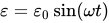

where
where
is frequency of strain oscillation,
is time,
is phase lag between stress and strain.
The stress relaxation modulus 


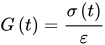
which is the time-dependent generalization of Hooke's law.
For visco-elastic solids, 
.
The Fourier transform of the shear relaxation modulus 

Storage and loss modulus
The storage and loss modulus in viscoelastic materials measure the stored energy, representing the elastic portion, and the energy dissipated as heat, representing the viscous portion. The tensile storage and loss moduli are defined as follows:
- Storage:
- Loss:
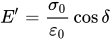
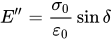
Similarly we also define shear storage and shear loss moduli, 

Complex variables can be used to express the moduli 



where 
Ratio between loss and storage modulus
The ratio of the loss modulus to storage modulus in a viscoelastic material is defined as the 
Tensile:

Shear:

For a material with a
Sources and credits
This article is adapted from the Wikipedia article “Dynamic modulus”, written by its contributors and licensed under CC BY-SA 4.0. Fathomly has changed the layout, removed citation markers, navigation and maintenance notices, and adjusted punctuation. This adapted version is shared under the same license. For references, see the original article.
Fathomly is not affiliated with or endorsed by the Wikimedia Foundation. Spotted a problem? Tell us.