Language model
Statistical model of language
A language model is a computational model that predicts sequences in natural language. Language models are useful for a variety of tasks, including speech recognition, machine translation, natural language generation (generating more human-like text), optical character recognition, route optimization, handwriting recognition, grammar induction, information retrieval and disaster response.
Large language models (LLMs), currently their most advanced form as of 2026, are predominantly based on transformers trained on larger datasets (frequently using texts scraped from the public internet). They have superseded recurrent neural network-based models, which had previously superseded the purely statistical models, such as the word n-gram language model.
01History
During the 1950s, Noam Chomsky developed influential formal approaches to describing language, including models based on formal grammar.
In the 1970s, Frederick Jelinek and colleagues at IBM Research developed statistical approaches to language modeling as part of their work on speech recognition. The group used probabilistic n-gram models of word sequences and introduced perplexity as an information-theoretic measure of the uncertainty of a language model. Jelinek became a leading proponent of statistical language modeling.
Neural language models became increasingly important in the 2000s, with Yoshua Bengio and co-authors introducing a probabilistic neural network language model that learned distributed word representations while estimating the probability of word sequences.
Recurrent neural networks extended this approach by retaining information from earlier words as the sequence was processed. Tomáš Mikolov and colleagues demonstrated in 2010 that recurrent neural-network language models could substantially outperform conventional n-gram models.


02Pure statistical models
In 1980, the first significant statistical language model was proposed, and during the decade IBM performed 'Shannon-style' experiments, in which potential sources for language modeling improvement were identified by observing and analyzing the performance of human subjects in predicting or correcting text.
Models based on word n-grams
A word n-gram language model is a statistical model of language which calculates the probability of the next word in a sequence from a fixed size window of previous words. If one previous word is considered, it is a bigram model; if two words, a trigram model; if n − 1 words, an n-gram model.
Special tokens are introduced to denote the start and end of a sentence 

Word n-gram models have largely been superseded by recurrent neural network, based models, which in turn have been superseded by Transformer-based models often referred to as large language models.
Exponential
Maximum entropy language models encode the relationship between a word and the n-gram history using feature functions. The equation is

where 

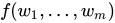
The log-bilinear model is another example of an exponential language model.
Skip-gram model
Skip-gram language model is an attempt at overcoming the data sparsity problem that the preceding model (i.e. word n-gram language model) faced. Words represented in an embedding vector were not necessarily consecutive anymore, but could leave gaps that are skipped over (thus the name "skip-gram").
Formally, a k-skip-n-gram is a length-n subsequence where the components occur at distance at most k from each other.
For example, in the input text:
- the rain in Spain falls mainly on the plain
the set of 1-skip-2-grams includes all the bigrams (2-grams), and in addition the subsequences
- the in, rain Spain, in falls, Spain mainly, falls on, mainly the, and on plain.
In skip-gram model, semantic relations between words are represented by linear combinations, capturing a form of compositionality. For example, in some such models, if v is the function that maps a word w to its n-d vector representation, then

where ≈ is made precise by stipulating that its right-hand side must be the nearest neighbor of the value of the left-hand side.

03Neural models
Recurrent neural network
Continuous representations or embeddings of words are produced in recurrent neural network-based language models (known also as continuous space language models). Such continuous space embeddings help to alleviate the curse of dimensionality, which is the consequence of the number of possible sequences of words increasing exponentially with the size of the vocabulary, further causing a data sparsity problem. Neural networks avoid this problem by representing words as non-linear combinations of weights in a neural net.
Large language models
A large language model (LLM) is an AI model (typically a neural network) trained on a vast amount of text for natural language processing tasks, especially language generation. LLMs can typically generate, summarize, translate, and analyze text in many contexts. They are the basis for many modern chatbots, such as ChatGPT, Claude, Gemini, Grok, and DeepSeek.
LLMs are typically based on transformer architecture. Generative pre-trained transformers (GPTs) are a type of LLM that is pre-trained to predict the next word. GPTs are then often fine-tuned to follow instructions and to behave as assistants.
Biased or inaccurate training data can make an LLM's output less reliable. Benchmark evaluations for LLMs attempt to measure model reasoning, factual accuracy, [[AI alignment|alignment]
Before the emergence of transformer-based models in 2017, some language models were considered large relative to the computational and data constraints of their time. In the early 1990s, IBM's statistical models pioneered word alignment techniques for machine translation, laying the groundwork for corpus-based language modeling. In 2001, a smoothed n-gram model, such as those employing Kneser-Ney smoothing, trained on 300 million words, achieved state-of-the-art perplexity on benchmark tests. During the 2000s, with the rise of widespread internet access, researchers began compiling massive text datasets from the web ("web as corpus") to train statistical language models.
Moving beyond n-gram models, researchers started in 2000 to use neural networks as language models. Following the breakthrough of deep neural networks in image classification around 2012, similar architectures were adapted for language tasks. This shift was marked by the development of word embeddings (e.g., Word2Vec by Mikolov in 2013) and sequence-to-sequence (seq2seq) models using LSTM. In 2016, Google transitioned its translation service to neural machine translation (NMT), replacing statistical phrase-based models with deep recurrent neural networks. These early NMT systems used LSTM-based encoder-decoder architectures, as they preceded the invention of transformers.At the 2017 NeurIPS conference, Google researchers introduced the transformer architecture in their landmark paper "Attention Is All You Need". This paper's goal was to improve upon 2014 seq2seq technology, and was based mainly on the attention mechanism developed by Bahdanau et al. in 2014. The following year in 2018, BERT was introduced and quickly became "ubiquitous". Though the original transformer has both encoder and decoder blocks, BERT is an encoder-only model. Academic and research usage of BERT began to decline in 2023, following rapid improvements in the abilities of decoder-only models (such as GPT) to solve tasks via prompting.
Although decoder-only GPT-1 was introduced in 2018, it was GPT-2 in 2019 that caught widespread attention because OpenAI claimed to have initially deemed it too powerful to release publicly, out of fear of malicious use. GPT-3 in 2020 went a step further and as of 2025 is available only via API with no offering of downloading the model to execute locally. But it was the consumer-facing chatbot ChatGPT in late 2022 that received extensive media coverage and public attention by 2023. The 2023 GPT-4 was praised for its increased accuracy and as a "holy grail" for its multimodal capabilities. OpenAI did not reveal the high-level architecture and the number of parameters of GPT-4. The release of ChatGPT led to an uptick in LLM usage across several research subfields of computer science, including robotics, software engineering, and societal impact work. In 2024, OpenAI released the reasoning model OpenAI o1, which generates long chains of thought before returning a final answer. Many LLMs with parameter counts comparable to those of OpenAI's GPT series have been developed.
Since 2022, open-source models (those with their source code and weights made publicly available) have been gaining popularity, especially at first with BLOOM and LLaMA, though both have restrictions on the field of use. Mistral AI's open-weight models Mistral 7B and Mixtral 8x7B have a more permissive Apache License. In January 2025, DeepSeek released DeepSeek R1, a 671-billion-parameter open-weight model that performs comparably to OpenAI o1 but at a much lower price per token for users.
Since 2023, many LLMs have been trained to be multimodal, having the ability to also process or generate other types of data, such as images, audio, or 3D meshes.
Open-weight LLMs have become more influential since 2023. Per Vake et al. (2025), community-driven contributions to open-weight models improve their efficiency and performance via collaborative platforms such as Hugging Face.
Although sometimes matching human performance, it is not clear whether they are plausible cognitive models. At least for recurrent neural networks, it has been shown that they sometimes learn patterns that humans do not, but fail to learn patterns that humans typically do.

04Evaluation and benchmarks
Evaluation of the quality of language models is mostly done by comparison to human created sample benchmarks created from typical language-oriented tasks. Other, less established, quality tests examine the intrinsic character of a language model or compare two such models. Since language models are typically intended to be dynamic and to learn from data they see, some proposed models investigate the rate of learning, e.g., through inspection of learning curves.
Various data sets have been developed for use in evaluating language processing systems. These include:
- Massive Multitask Language Understanding (MMLU)
- Corpus of Linguistic Acceptability
- GLUE benchmark
- Microsoft Research Paraphrase Corpus
- Multi-Genre Natural Language Inference
- Question Natural Language Inference
- Quora Question Pairs
- Recognizing Textual Entailment
- Semantic Textual Similarity Benchmark
- SQuAD question answering Test
- Stanford Sentiment Treebank
- Winograd NLI
- BoolQ, PIQA, SIQA, HellaSwag, WinoGrande, ARC, OpenBookQA, NaturalQuestions, TriviaQA, RACE, BIG-bench hard, GSM8k, RealToxicityPrompts, WinoGender, CrowS-Pairs

Sources and credits
This article is adapted from the Wikipedia article “Language model”, written by its contributors and licensed under CC BY-SA 4.0. Fathomly has changed the layout, removed citation markers, navigation and maintenance notices, and adjusted punctuation. This adapted version is shared under the same license. For references, see the original article.
Images, from Wikimedia Commons:
- 1-skip-2-gram.svg by Cosmia Nebula, CC BY-SA 4.0
- The number of publications about Large Language Models by year.png by ApoieRacional, CC BY-SA 4.0
- Trends in AI training FLOP over time (2010-2025).svg by Epoch AI, CC BY 4.0
- Large-scale AI training compute (FLOP) vs Publication date (2017-2024).svg by Epoch AI, CC BY 4.0
- The-Transformer-model-architecture.png by Yuening Jia, CC BY-SA 3.0
Fathomly is not affiliated with or endorsed by the Wikimedia Foundation. Spotted a problem? Tell us.
