Standard part function
Function from the limited hyperreal to the real numbers
In nonstandard analysis, the standard part function is a function from the limited (finite) hyperreal numbers to the real numbers. Briefly, the standard part function "rounds off" a finite hyperreal to the nearest real. It associates to every such hyperreal 


The standard part function was first defined by Abraham Robinson who used the notation 
01Definition
Nonstandard analysis deals primarily with the pair 


The standard part of any infinitesimal is 0. Thus if N is an infinite hypernatural, then 1/N is infinitesimal, and st(1/N) = 0.
If a hyperreal 

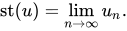
More generally, each finite 


02Not internal
The standard part function "st" is not defined by an internal set. There are several ways of explaining this. Perhaps the simplest is that its domain L, which is the collection of limited (i.e. finite) hyperreals, is not an internal set. Namely, since L is bounded (by any infinite hypernatural, for instance), L would have to have a least upper bound if L were internal, but L doesn't have a least upper bound. Alternatively, the range of "st" is
03Applications
All the traditional notions of calculus can be expressed in terms of the standard part function, as follows.
Derivative
The standard part function is used to define the derivative of a function f. If f is a real function, and h is infinitesimal, and if f′(x) exists, then
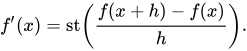
Alternatively, if 



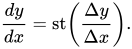
Integral
Given a function 
![[a,b]](https://wikimedia.org/api/rest_v1/media/math/render/svg/9c4b788fc5c637e26ee98b45f89a5c08c85f7935)

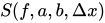
Limit
Given a sequence 


Continuity
A real function 
Sources and credits
This article is adapted from the Wikipedia article “Standard part function”, written by its contributors and licensed under CC BY-SA 4.0. Fathomly has changed the layout, removed citation markers, navigation and maintenance notices, and adjusted punctuation. This adapted version is shared under the same license. For references, see the original article.
Images, from Wikimedia Commons:
- Standard part function with two continua.svg by User:Kephir, CC0
Fathomly is not affiliated with or endorsed by the Wikimedia Foundation. Spotted a problem? Tell us.