Prestack
Algebraic geometry category satisfying lifting conditions
In algebraic geometry, a prestack F over a category C equipped with some Grothendieck topology is a category together with a functor p: F → C satisfying a certain lifting condition and such that (when the fibers are groupoids) locally isomorphic objects are isomorphic. A stack is a prestack with effective descents, meaning local objects may be patched together to become a global object.
Prestacks that appear in nature are typically stacks but some naively constructed prestacks (e.g., groupoid scheme or the prestack of projectivized vector bundles) may not be stacks. Prestacks may be studied on their own or passed to stacks.
Since a stack is a prestack, all the results on prestacks are valid for stacks as well. Throughout the article, we work with a fixed base category C; for example, C can be the category of all schemes over some fixed scheme equipped with some Grothendieck topology.
01Informal definition
Let F be a category and suppose it is fibered over C through the functor 
Given an object U in C and objects x, y in 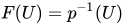


![{\underline {\operatorname {Hom} }}(x,y)(V{\overset {f}{\to }}U)=[\operatorname {Hom} (f^{*}x,f^{*}y)]](https://wikimedia.org/api/rest_v1/media/math/render/svg/d0e7de773177b85a60ea2affdc7365ae3f18d58c)
be the set of all morphisms from 



![[\operatorname {Hom} (f^{*}x,f^{*}y)]{\overset {g^{*}}{\to }}[\operatorname {Hom} (g^{*}(f^{*}x),g^{*}(f^{*}y))]=[\operatorname {Hom} ((f\circ g)^{*}x,(f\circ g)^{*}y)]](https://wikimedia.org/api/rest_v1/media/math/render/svg/d1976a1aa4f7de3d2431864dc01d68f35d62d896)
where a canonical isomorphism 


By definition, F is a prestack if, for each pair x, y,
This definition can be equivalently phrased as follows. First, for each covering family 
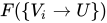

- an object is a set
of pairs consisting of objects
in
and isomorphisms
that satisfy the cocycle condition:
- a morphism
consists of
in


An object of this category is called a descent datum. This category is not well-defined; the issue is that the pullbacks are determined only up to canonical isomorphisms; similarly fiber products are defined only up to canonical isomorphisms, despite the notational practice to the contrary. In practice, one simply makes some canonical identifications of pullbacks, their compositions, fiber products, etc.; up to such identifications, the above category is well-defined (in other words, it is defined up to a canonical equivalence of categories.)
There is an obvious functor 
The essential image of
These reformulations of the definitions of prestacks and stacks make intuitive meanings of those concepts very explicit: (1) "fibered category" means one can construct a pullback (2) "prestack in groupoids" additionally means "locally isomorphic" implies "isomorphic" (3) "stack in groupoids" means, in addition to the previous properties, a global object can be constructed from local data subject to cocycle conditions. All these work up to canonical isomorphisms.
02Morphisms
Definitions
Given prestacks 


If 



where 
Fiber product
Let 

- an object is a triple
consisting of an object x in F, an object y in G, both over the same object in C, and an isomorphism
in G over the identity morphism in C, and
- a morphism
consists of
in F,
in G, both over the same morphism in C, such that
.
It comes with the forgetful functors p, q from 
This fiber product behaves like a usual fiber product but up to natural isomorphisms. The meaning of this is the following. Firstly, the obvious square does not commute; instead, for each object
.
That is, there is an invertible natural transformation (= natural isomorphism)
.
Secondly, it satisfies the strict universal property: given a prestack H, morphisms 






When B is the base category C (the prestack over itself), B is dropped and one simply writes 

Example: For each prestack 


Example: Given 

Example: Given 
;
this isomorphism is constructed simply by hand.
Representable morphisms
A morphism of prestacks 


In particular, the definition applies to the structure map 
The definition applies also to the diagonal morphism 


If 


03Example: the prestack given by an action of an algebraic group
Let G be an algebraic group acting from the right on a scheme X of finite type over a field k. Then the group action of G on X determines a prestack (but not a stack) over the category C of k-schemes, as follows. Let F be the category where
- an object is a pair
consisting of a scheme U in C and x in the set
,
- a morphism
consists of an
in C and an element
such that xg = y' where we wrote
.
Through the forgetful functor to C, this category F is fibered in groupoids and is known as an action groupoid or a transformation groupoid. It may also be called the quotient prestack of X by G and be denoted as ![[X/G]^{pre}](https://wikimedia.org/api/rest_v1/media/math/render/svg/74f9977b2460dc6c247422e228c53417d12cb205)
![[X/G]](https://wikimedia.org/api/rest_v1/media/math/render/svg/6c10708eac95ed8fcce0dd132f18c6d844536ebf)
When X is a point 
![[*/G]^{pre}=BG^{pre}](https://wikimedia.org/api/rest_v1/media/math/render/svg/7fb7cff556ee3ac7ef369430ed9b13837c987f4a)
One viewing X as a prestack (in fact a stack), there is the obvious canonical map

over C; explicitly, each object 

Then the above canonical map fits into a 2-coequalizer (a 2-quotient):
,
where t: (x, g) → xg is the given group action and s a projection. It is not 1-coequalizer since, instead of the equality 


04The prestack of equivalence classes
Let X be a scheme in the base category C. By definition, an equivalence pre-relation is a morphism 


Example: Let an algebraic group G act on a scheme X of finite type over a field k. Take 

By Yoneda's lemma, this determines a morphism f, which is clearly an equivalence pre-relation.
To each given equivalence pre-relation 

- an object is a pair
consisting of a scheme T and a morphism x: T → X in C
- a morphism
consists of a
and
such that
and
- the composition of
followed by
consists of
and
obtained as follows: since
, by the universal property, there is an induced map
.
be
followed by the multiplication
- the identity morphism for an object
followed by
; the latter is obtained by factorizing the diagonal morphism through f, possible by reflexivity.

Via a forgetful functor, the category F is fibered in groupoids. Finally, we check F is a prestack; for that, notice: for objects x, y in F(U) and an object
![{\begin{aligned}{\underline {\operatorname {Hom} }}(x,y)(V{\overset {f}{\to }}U)&=[\operatorname {Hom} (f^{*}x,f^{*}y)]\\&=[\{\delta :V\to R|s\circ \delta =f^{*}x,t\circ \delta =f^{*}y\}]\\&=[\{\delta :V\to R|(s,t)\circ \delta =(x,y)\circ f\}].\end{aligned}}](https://wikimedia.org/api/rest_v1/media/math/render/svg/28ef55b7927e941e80817efcb46c80ebbaf52dec)
Now, this means that 

The prestack F above may be written as ![[X/\sim _{R}]^{pre}](https://wikimedia.org/api/rest_v1/media/math/render/svg/22a147e4e5d5ca8d43790af920a17cb11cd19b95)
![[X/\sim _{R}]](https://wikimedia.org/api/rest_v1/media/math/render/svg/0a61697b2c20b647491031ae8146dfd57f62560b)
Note, when X is viewed as a stack, both X and 
One importance of this construction is that it provides an atlas for an algebraic space: every algebraic space is of the form ![[U/\sim _{R}]](https://wikimedia.org/api/rest_v1/media/math/render/svg/6d99afd072438524e2ce3d7dcddf0948f89f2c9e)



Starting from a Deligne-Mumford stack 
![{\mathfrak {X}}\simeq [U/\sim _{R}]](https://wikimedia.org/api/rest_v1/media/math/render/svg/cff3d7206ebceb82602b4ab76c99753404d6e1bb)



be the first and second projections. Taking 

- Extend
(nothing changes on the object-level; we only need to explain how to send
- By the universal property of stackification,
factors through
.
- Check the last map is an isomorphism.
05Stacks associated to prestacks
There is a way to associate a stack to a given prestack. It is similar to the sheafification of a presheaf and is called stackification. The idea of the construction is quite simple: given a prestack
As it turns out, it is a stack and comes with a natural morphism 
In some special cases, the stackification can be described in terms of torsors for affine group schemes or the generalizations. In fact, according to this point of view, a stack in groupoids is nothing but a category of torsors, and a prestack a category of trivial torsors, which are local models of torsors.
Sources and credits
This article is adapted from the Wikipedia article “Prestack”, written by its contributors and licensed under CC BY-SA 4.0. Fathomly has changed the layout, removed citation markers, navigation and maintenance notices, and adjusted punctuation. This adapted version is shared under the same license. For references, see the original article.
Fathomly is not affiliated with or endorsed by the Wikimedia Foundation. Spotted a problem? Tell us.