Stable module category
In mathematics, especially representation theory, the stable module category is a quotient of a module category in which projectives are "factored out."
01Definition
Let R be a ring. For two modules M and N over R, define 
Given a module M, let P be a projective module with a surjection 


For certain rings, such as Frobenius algebras, 


The functor Ω−1 can even be defined on the module category of a general ring (without factoring out projectives), as the cokernel of the injective envelope. It need not be true in this case that the functor Ω−1 is actually an inverse to Ω. One important property of the stable module category is it allows defining the Ω functor for general rings. When R is perfect (or M is finitely generated and R is semiperfect), then Ω(M) can be defined as the kernel of the projective cover, giving a functor on the module category. However, in general projective covers need not exist, and so passing to the stable module category is necessary.
02Connections with cohomology
Now we suppose that R = kG is a group algebra for some field k and some group G. One can show that there exist isomorphisms

for every positive integer n. The group cohomology of a representation M is given by 
Furthermore, the above isomorphism suggests defining cohomology groups for negative values of n, and in this way one recovers Tate cohomology.
03Triangulated structure

in the usual module category defines an element of 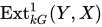
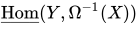

Taking
Sources and credits
This article is adapted from the Wikipedia article “Stable module category”, written by its contributors and licensed under CC BY-SA 4.0. Fathomly has changed the layout, removed citation markers, navigation and maintenance notices, and adjusted punctuation. This adapted version is shared under the same license. For references, see the original article.
Fathomly is not affiliated with or endorsed by the Wikimedia Foundation. Spotted a problem? Tell us.