Spirograph
Geometric drawing device

Spirograph is a geometric drawing device that produces mathematical roulette curves of the variety technically known as hypotrochoids and epitrochoids. The well-known toy version was developed by British engineer Denys Fisher and first sold in 1965.
The name has been a registered trademark of Hasbro Inc. since 1998 following purchase of the company that had acquired the Denys Fisher company. The Spirograph brand was relaunched worldwide in 2013, with its original product configurations, by Kahootz Toys.
01History
In 1827, Greek-born English architect and engineer Peter Hubert Desvignes developed and advertised a "Speiragraph", a device to create elaborate spiral drawings. A man named J. Jopling soon claimed to have previously invented similar methods. When working in Vienna between 1845 and 1848, Desvignes constructed a version of the machine that would help prevent banknote forgeries, as any of the nearly endless variations of roulette patterns that it could produce were extremely difficult to reverse engineer. The mathematician Bruno Abakanowicz invented a new Spirograph device between 1881 and 1900. It was used for calculating an area delimited by curves.
Drawing toys based on gears have been around since at least 1908, when The Marvelous Wondergraph was advertised in the Sears catalog. An article describing how to make a Wondergraph drawing machine appeared in the Boys Mechanic publication in 1913.
The definitive Spirograph toy was developed by the British engineer Denys Fisher between 1962 and 1964 by creating drawing machines with Meccano pieces. Fisher exhibited his spirograph at the 1965 Nuremberg International Toy Fair. It was subsequently produced by his company. US distribution rights were acquired by Kenner, Inc., which introduced it to the United States market in 1966 and promoted it as a creative children's toy. Kenner later introduced Spirotot, Magnetic Spirograph, Spiroman, and various refill sets.
In 2013 the Spirograph brand was re-launched worldwide, with the original gears and wheels, by Kahootz Toys. The modern products use removable putty in place of pins to hold the stationary pieces in place. The Spirograph was Toy of the Year in 1967, and Toy of the Year finalist, in two categories, in 2014. Kahootz Toys was acquired by PlayMonster LLC in 2019.

02Operation
The original US-released Spirograph consisted of two differently sized plastic rings (or stators), with gear teeth on both the inside and outside of their circumferences. Once either of these rings were held in place (either by pins, with an adhesive, or by hand) any of several provided gearwheels (or rotors), each having holes for a ballpoint pen, could be spun around the ring to draw geometric shapes. Later, the Super-Spirograph introduced additional shapes such as rings, triangles, and straight bars. All edges of each piece have teeth to engage any other piece; smaller gears fit inside the larger rings, but they also can rotate along the rings' outside edge or even around each other. Gears can be combined in many different arrangements. Sets often included variously colored pens, which could enhance a design by switching colors, as seen in the examples shown here.

03Mathematical basis
Consider a fixed outer circle 


Now mark two points 

Now define the new (relative) system of coordinates 


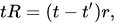
or equivalently,
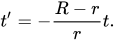
It is common to assume that a counterclockwise motion corresponds to a positive change of angle and a clockwise one to a negative change of angle. A minus sign in the above formula (
Let 

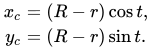
As defined above, 
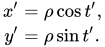
In order to obtain the trajectory of

where 
Now, use the relation between
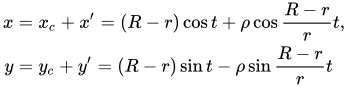
(using the fact that function 
It is convenient to represent the equation above in terms of the radius

and

The parameter 

It is now observed that

and therefore the trajectory equations take the form
![{\begin{aligned}x(t)&=R\left[(1-k)\cos t+lk\cos {\frac {1-k}{k}}t\right],\\y(t)&=R\left[(1-k)\sin t-lk\sin {\frac {1-k}{k}}t\right].\\\end{aligned}}](https://wikimedia.org/api/rest_v1/media/math/render/svg/5f1b39a37ec7e9d19341c5424fd55323f5e94a40)
Parameter
The two extreme cases 


The other extreme case 

If 

Sources and credits
This article is adapted from the Wikipedia article “Spirograph”, written by its contributors and licensed under CC BY-SA 4.0. Fathomly has changed the layout, removed citation markers, navigation and maintenance notices, and adjusted punctuation. This adapted version is shared under the same license. For references, see the original article.
Images, from Wikimedia Commons:
- Spirograph plus (8417026572).jpg by James Petts from London, England, CC BY-SA 2.0
- Spirograph set (UK Palitoy early 1980s) (ii) (perspective fixed).jpg by Multicherry, CC BY-SA 3.0
- Early Spirograph box.jpg by Rathfelder, CC0
- Resonance Cascade.svg by Krishnavedala, CC BY-SA 4.0
Fathomly is not affiliated with or endorsed by the Wikimedia Foundation. Spotted a problem? Tell us.

