Spin tensor
Spinning motion in theoretical physics
In mathematics, mathematical physics, and theoretical physics, the spin tensor is a quantity used to describe the rotational motion of particles in spacetime. The spin tensor has application in general relativity and special relativity, as well as quantum mechanics, relativistic quantum mechanics, and quantum field theory.
The special Euclidean group SE(d) of direct isometries is generated by translations and rotations. Its Lie algebra is written 
This article uses Cartesian coordinates and tensor index notation.
01Background on Noether currents
The Noether current for translations in space is momentum, while the current for increments in time is energy. These two statements combine into one in spacetime: translations in spacetime, i.e. a displacement between two events, is generated by the four-momentum P. Conservation of four-momentum is given by the continuity equation:

where 
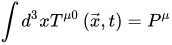
gives the four-momentum vector at time t.
The Noether current for a rotation about the point y is given by a tensor of 3rd order, denoted 

where the 0 subscript indicates the origin (unlike momentum, angular momentum depends on the origin), the integral:
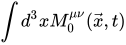
gives the angular momentum tensor 
02Definition
The spin tensor is defined at a point x to be the value of the Noether current at x of a rotation about x,

The continuity equation
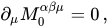
implies:

and therefore, the stress-energy tensor is not a symmetric tensor.
The quantity S is the density of spin angular momentum (spin in this case is not only for a point-like particle, but also for an extended body), and M is the density of orbital angular momentum. The total angular momentum is always the sum of spin and orbital contributions.
The relation:

gives the torque density showing the rate of conversion between the orbital angular momentum and spin.
03Examples
Examples of materials with a nonzero spin density are molecular fluids, the electromagnetic field and turbulent fluids. For molecular fluids, the individual molecules may be spinning. The electromagnetic field can have circularly polarized light. For turbulent fluids, we may arbitrarily make a distinction between long wavelength phenomena and short wavelength phenomena. A long wavelength vorticity may be converted via turbulence into tinier and tinier vortices transporting the angular momentum into smaller and smaller wavelengths while simultaneously reducing the vorticity. This can be approximated by the eddy viscosity.
Sources and credits
This article is adapted from the Wikipedia article “Spin tensor”, written by its contributors and licensed under CC BY-SA 4.0. Fathomly has changed the layout, removed citation markers, navigation and maintenance notices, and adjusted punctuation. This adapted version is shared under the same license. For references, see the original article.
Fathomly is not affiliated with or endorsed by the Wikimedia Foundation. Spotted a problem? Tell us.

