Spherinder
Geometric object

In four-dimensional geometry, the spherinder, or spherical cylinder or spherical prism, is a geometric object, defined as the Cartesian product of a 3-ball (or solid 2-sphere) of radius r1 and a line segment of length 2r2:

Like the duocylinder, it is also analogous to a cylinder in 3-space, which is the Cartesian product of a disk with a line segment. It is a rotatope and a toratope.
It can be seen in 3-dimensional space by stereographic projection as two concentric spheres, in a similar way that a tesseract (cubic prism) can be projected as two concentric cubes, and how a circular cylinder can be projected into 2-dimensional space as two concentric circles.
01Spherindrical coordinate system
One can define a "spherindrical" coordinate system (r, θ, φ, w), consisting of spherical coordinates with an extra coordinate w. This is analogous to how cylindrical coordinates are defined: r and φ being polar coordinates with an elevation coordinate z. Spherindrical coordinates can be converted to Cartesian coordinates using the formulas 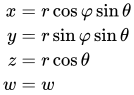



02Measurements
Hypervolume
Given a spherinder with a spherical base of radius r and a height h, the hypervolume of the spherinder is given by

Surface volume
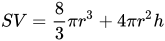
The surface volume of a spherinder, like the surface area of a cylinder, is made up of three parts:
- the volume of the top base:
- the volume of the bottom base:
- the volume of the lateral 3D surface:
, which is the surface area of the spherical base times the height

Therefore, the total surface volume is
Proof
The above formulas for hypervolume and surface volume can be proven using integration. The hypervolume of an arbitrary 4D region is given by the quadruple integral
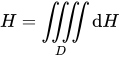
The hypervolume of the spherinder can be integrated over spherindrical coordinates.

Sources and credits
This article is adapted from the Wikipedia article “Spherinder”, written by its contributors and licensed under CC BY-SA 4.0. Fathomly has changed the layout, removed citation markers, navigation and maintenance notices, and adjusted punctuation. This adapted version is shared under the same license. For references, see the original article.
Images, from Wikimedia Commons:
- Couronne solide.svg by Sylvie Martin, CC BY-SA 4.0
- Truncated icosidodecahedral prism.png by The original uploader was Tomruen at English Wikipedia., Attribution
Fathomly is not affiliated with or endorsed by the Wikimedia Foundation. Spotted a problem? Tell us.
