Spherical pendulum
3-Dimensional analogue of a pendulum

In physics, a spherical pendulum is a higher dimensional analogue of the pendulum. It consists of a mass m moving without friction on the surface of a sphere. The only forces acting on the mass are the reaction from the sphere and gravity.
It is convenient to use the spherical coordinates to describe the position of the mass in terms of 

01Lagrangian mechanics
Routinely, in order to write down the kinetic 


.


Next, time derivatives of these coordinates are taken, to obtain velocities along the axes
.


Thus,

and


The Lagrangian, with constant parts removed, is

The Euler-Lagrange equation involving the polar angle
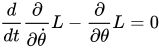
gives

and

When 
Similarly, the Euler-Lagrange equation involving the azimuth 
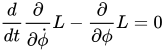
gives
.
The last equation shows that angular momentum around the vertical axis, 

The second order differential equation determining the evolution of
.
The azimuth
The conical pendulum refers to the special solutions where 


02Hamiltonian mechanics
The Hamiltonian is

where conjugate momenta are
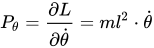
and
.
In terms of coordinates and momenta it reads
![H=\underbrace {\left[{\frac {1}{2}}ml^{2}{\dot {\theta }}^{2}+{\frac {1}{2}}ml^{2}\sin ^{2}\theta {\dot {\phi }}^{2}\right]} _{T}+\underbrace {{\bigg [}-mgl\cos \theta {\bigg ]}} _{V}={P_{\theta }^{2} \over 2ml^{2}}+{P_{\phi }^{2} \over 2ml^{2}\sin ^{2}\theta }-mgl\cos \theta](https://wikimedia.org/api/rest_v1/media/math/render/svg/0c4b7476a113f2067241e09d80ffab01076fbd3b)
Hamilton's equations will give time evolution of coordinates and momenta in four first-order differential equations

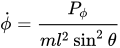
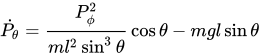

Momentum 
03Trajectory
Trajectory of the mass on the sphere can be obtained from the expression for the total energy
![E=\underbrace {\left[{\frac {1}{2}}ml^{2}{\dot {\theta }}^{2}+{\frac {1}{2}}ml^{2}\sin ^{2}\theta {\dot {\phi }}^{2}\right]} _{T}+\underbrace {{\bigg [}-mgl\cos \theta {\bigg ]}} _{V}](https://wikimedia.org/api/rest_v1/media/math/render/svg/9a7c71e33f8c8fec5de31a3f9ead6918ad2eac4f)
by noting that the vertical component of angular momentum 
Hence

![\left({\frac {d\theta }{dt}}\right)^{2}={\frac {2}{ml^{2}}}\left[E-{\frac {1}{2}}{\frac {L_{z}^{2}}{ml^{2}\sin ^{2}\theta }}+mgl\cos \theta \right]](https://wikimedia.org/api/rest_v1/media/math/render/svg/743df9be7b10527d8ce22bb907390d1bc09d3309)
which leads to an elliptic integral of the first kind for
![t(\theta )={\sqrt {{\tfrac {1}{2}}ml^{2}}}\int \left[E-{\frac {1}{2}}{\frac {L_{z}^{2}}{ml^{2}\sin ^{2}\theta }}+mgl\cos \theta \right]^{-{\frac {1}{2}}}\,d\theta](https://wikimedia.org/api/rest_v1/media/math/render/svg/1e232c62317bab07efd86d2c4c851acbf6139155)
and an elliptic integral of the third kind for
.
The angle 
.
Sources and credits
This article is adapted from the Wikipedia article “Spherical pendulum”, written by its contributors and licensed under CC BY-SA 4.0. Fathomly has changed the layout, removed citation markers, navigation and maintenance notices, and adjusted punctuation. This adapted version is shared under the same license. For references, see the original article.
Images, from Wikimedia Commons:
- Spherical pendulum Lagrangian mechanics.svg by Maschen, CC0
- SphaerischesPendelAnima.gif by Modalanalytiker, CC BY-SA 4.0
Fathomly is not affiliated with or endorsed by the Wikimedia Foundation. Spotted a problem? Tell us.

