Specific storage
Amount of water an aquifer releases while staying saturated
In the field of hydrogeology, storage properties are physical properties that characterize the capacity of an aquifer to release groundwater. These properties are storativity (S), specific storage (Ss) and specific yield (Sy). According to Groundwater, by Freeze and Cherry (1979), specific storage, 
They are often determined using some combination of field tests (e.g., aquifer tests) and laboratory tests on aquifer material samples. Recently, these properties have been also determined using remote sensing data derived from Interferometric synthetic-aperture radar.
01Storativity
Definition
Storativity or the storage coefficient is the volume of water released from storage per unit decline in hydraulic head in the aquifer, per unit area of the aquifer. Storativity is a dimensionless quantity, and is always greater than 0.
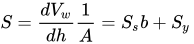
is the volume of water released from storage ([L3]);
is the hydraulic head ([L])
is the specific yield
is the thickness of aquifer
is the area ([L2])
Confined
For a confined aquifer or aquitard, storativity is the vertically integrated specific storage value. Specific storage is the volume of water released from one unit volume of the aquifer under one unit decline in head. This is related to both the compressibility of the aquifer and the compressibility of the water itself. Assuming the aquifer or aquitard is homogeneous:

Unconfined
For an unconfined aquifer, storativity is approximately equal to the specific yield (

The specific storage is the amount of water that a portion of an aquifer releases from storage, per unit mass or volume of the aquifer, per unit change in hydraulic head, while remaining fully saturated.
Mass specific storage is the mass of water that an aquifer releases from storage, per mass of aquifer, per unit decline in hydraulic head:
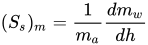
where
is the mass specific storage ([L−1]);
is the mass of that portion of the aquifer from which the water is released ([M]);
is the mass of water released from storage ([M]); and
is the decline in hydraulic head ([L]).
Volumetric specific storage (or volume-specific storage) is the volume of water that an aquifer releases from storage, per volume of the aquifer, per unit decline in hydraulic head (Freeze and Cherry, 1979):

where
is the bulk volume of that portion of the aquifer from which the water is released ([L3]);
is the volume of water released from storage ([L3]);
is the decline in pressure(N•m−2 or [ML−1T−2]) ;
is the specific weight of water (N•m−3 or [ML−2T−2]).
In hydrogeology, volumetric specific storage is much more commonly encountered than mass specific storage. Consequently, the term specific storage generally refers to volumetric specific storage.
In terms of measurable physical properties, specific storage can be expressed as

where
is the porosity of the material (dimensionless ratio between 0 and 1)
is the compressibility of the bulk aquifer material (m2N−1 or [LM−1T2]), and
is the compressibility of water (m2N−1 or [LM−1T2])
The compressibility terms relate a given change in stress to a change in volume (a strain). These two terms can be defined as:

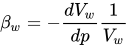
where
is the effective stress (N/m2 or [MLT−2/L2])
These equations relate a change in total or water volume (

Determination of the storage coefficient of aquifer systems
Aquifer-test analysis
Aquifer-test analyses provide estimates of aquifer-system storage coefficients by examining the drawdown and recovery responses of water levels in wells to applied stresses, typically induced by pumping from nearby wells.
Stress-strain analysis
Elastic and inelastic skeletal storage coefficients can be estimated through a graphical method developed by Riley. This method involves plotting the applied stress (hydraulic head) on the y-axis against vertical strain or displacement (compaction) on the x-axis. The inverse slopes of the dominant linear trends in these compaction-head trajectories indicate the skeletal storage coefficients. The displacements used to build the stress-strain curve can be determined by extensometers, InSAR or levelling.
Laboratory consolidation tests
Laboratory consolidation tests yield measurements of the coefficient of consolidation within the inelastic range and provide estimates of vertical hydraulic conductivity. The inelastic skeletal specific storage of the sample can be determined by calculating the ratio of vertical hydraulic conductivity to the coefficient of consolidation.
Model simulations and calibration
Simulations of land subsidence incorporate data on aquifer-system storage and hydraulic conductivity. Calibrating these models can lead to optimized estimates of storage coefficients and vertical hydraulic conductivity.
02Specific yield
| Material | Specific Yield (%) | ||
|---|---|---|---|
| min | avg | max | |
| Unconsolidated deposits | |||
| Clay | 0 | 2 | 5 |
| Sandy clay (mud) | 3 | 7 | 12 |
| Silt | 3 | 8 | 19 |
| Fine sand | 10 | 21 | 28 |
| Medium sand | 15 | 26 | 32 |
| Coarse sand | 20 | 27 | 35 |
| Gravelly sand | 20 | 25 | 35 |
| Fine gravel | 21 | 25 | 35 |
| Medium gravel | 13 | 23 | 26 |
| Coarse gravel | 12 | 22 | 26 |
| Consolidated deposits | |||
| Fine-grained sandstone | 21 | ||
| Medium-grained sandstone | 27 | ||
| Limestone | 14 | ||
| Schist | 26 | ||
| Siltstone | 12 | ||
| Tuff | 21 | ||
| Other deposits | |||
| Dune sand | 38 | ||
| Loess | 18 | ||
| Peat | 44 | ||
| Till, predominantly silt | 6 | ||
| Till, predominantly sand | 16 | ||
| Till, predominantly gravel | 16 | ||
Specific yield, also known as the drainable porosity, is a ratio and is the volumetric fraction of the bulk aquifer volume that a given aquifer will yield when all the water is allowed to drain out of it under the forces of gravity:

where
is the volume of water drained, and
is the total rock or material volume
It is primarily used for unconfined aquifers since the elastic storage component,
Sources and credits
This article is adapted from the Wikipedia article “Specific storage”, written by its contributors and licensed under CC BY-SA 4.0. Fathomly has changed the layout, removed citation markers, navigation and maintenance notices, and adjusted punctuation. This adapted version is shared under the same license. For references, see the original article.
Fathomly is not affiliated with or endorsed by the Wikimedia Foundation. Spotted a problem? Tell us.
