Specific force
Concept in physics
Specific force (SF) is a mass-specific quantity defined as the quotient of force per unit mass.

It is a physical quantity of kind acceleration, with dimension of length per time squared (T-2L) and SI units of metre per second squared (m·s−2).
It is normally applied to forces other than gravity, to emulate the relationship between gravitational acceleration and gravitational force. It can also be called mass-specific weight (weight per unit mass), as the weight of an object is equal to the magnitude of the gravity force acting on it.
The g-force is an instance of specific force measured in units of the standard gravity (g) instead of m/s², i.e., in multiples of g (e.g., "3 g").
01Type of acceleration
The (mass-)specific force is not a coordinate acceleration, but rather a proper acceleration, which is the acceleration relative to free-fall. Forces, specific forces, and proper accelerations are the same in all reference frames, but coordinate accelerations are frame-dependent. For free bodies, the specific force is the cause of, and a measure of, the body's proper acceleration.
The acceleration of an object free falling towards the Earth depends on the reference frame (it disappears in the free-fall frame, also called the inertial frame), but any g-force "acceleration" will be present in all frames. This specific force is zero for freely-falling objects, since gravity acting alone does not produce g-forces or specific forces.
Accelerometers on the surface of the Earth measure a constant 9.8 m/s^2 even when they are not accelerating (that is, when they do not undergo coordinate acceleration). This is because accelerometers measure the proper acceleration produced by the g-force exerted by the ground (gravity acting alone never produces g-force or specific force). Accelerometers measure specific force (proper acceleration), which is the acceleration relative to free-fall, not the "standard" acceleration that is relative to a coordinate system.
02Hydraulics
In open channel hydraulics, specific force (
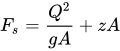
where Q is the discharge, g is the acceleration due to gravity, A is the cross-sectional area of flow, and z is the depth of the centroid of flow area A.
Sources and credits
This article is adapted from the Wikipedia article “Specific force”, written by its contributors and licensed under CC BY-SA 4.0. Fathomly has changed the layout, removed citation markers, navigation and maintenance notices, and adjusted punctuation. This adapted version is shared under the same license. For references, see the original article.
Fathomly is not affiliated with or endorsed by the Wikimedia Foundation. Spotted a problem? Tell us.

