Source transformation
Process of simplifying circuit solutions
Source transformation is the process of simplifying a circuit solution, especially with mixed sources, by transforming voltage sources into current sources, and vice versa, using Thévenin's theorem and Norton's theorem respectively.
01Process
Performing a source transformation consists of using Ohm's law to take an existing voltage source in series with a resistance, and replacing it with a current source in parallel with the same resistance, or vice versa. The transformed sources are considered identical and can be substituted for one another in a circuit.
Source transformations are not limited to resistive circuits. They can be performed on a circuit involving capacitors and inductors as well, by expressing circuit elements as impedances and sources in the frequency domain. In general, the concept of source transformation is an application of Thévenin's theorem to a current source, or Norton's theorem to a voltage source. However, this means that source transformation is bound by the same conditions as Thevenin's theorem and Norton's theorem; namely that the load behaves linearly, and does not contain dependent voltage or current sources.
Source transformations are used to exploit the equivalence of a real current source and a real voltage source, such as a battery. Application of Thévenin's theorem and Norton's theorem gives the quantities associated with the equivalence. Specifically, given a real current source, which is an ideal current source 


02Example calculation
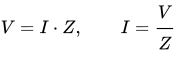
Source transformations are easy to compute using Ohm's law. If there is a voltage source in series with an impedance, it is possible to find the value of the equivalent current source in parallel with the impedance by dividing the value of the voltage source by the value of the impedance. The converse also holds: if a current source in parallel with an impedance is present, multiplying the value of the current source with the value of the impedance provides the equivalent voltage source in series with the impedance. A visual example of a source transformation can be seen in Figure 1.
03A brief proof of the theorem
The transformation can be derived from the uniqueness theorem. In the present context, it implies that a black box with two terminals must have a unique well-defined relation between its voltage and current. It is readily to verify that the above transformation indeed gives the same V-I curve, and therefore the transformation is valid.
Sources and credits
This article is adapted from the Wikipedia article “Source transformation”, written by its contributors and licensed under CC BY-SA 4.0. Fathomly has changed the layout, removed citation markers, navigation and maintenance notices, and adjusted punctuation. This adapted version is shared under the same license. For references, see the original article.
Images, from Wikimedia Commons:
- Sourcetrans.jpg by Unknown author, Cc-by-sa-3.0
Fathomly is not affiliated with or endorsed by the Wikimedia Foundation. Spotted a problem? Tell us.


