Snub trihexagonal tiling
Semiregular tiling of the Euclidean plane

| Snub trihexagonal tiling | |
|---|---|
| Type | Semiregular tiling |
| Vertex configuration | 3.3.3.3.6 |
| Schläfli symbol | sr{6,3} or  |
| Wythoff symbol | | 6 3 2 |
| Coxeter diagram | |
| Symmetry | p6, [6,3]+, (632) |
| Rotation symmetry | p6, [6,3]+, (632) |
| Bowers acronym | Snathat |
| Dual | Floret pentagonal tiling |
| Properties | Vertex-transitive chiral |
In geometry, the snub hexagonal tiling (or snub trihexagonal tiling) is a semiregular tiling of the Euclidean plane. There are four triangles and one hexagon on each vertex. It has Schläfli symbol sr{3,6}. The snub tetrahexagonal tiling is a related hyperbolic tiling with Schläfli symbol sr{4,6}.
Conway calls it a snub hextille, constructed as a snub operation applied to a hexagonal tiling (hextille).
There are three regular and eight semiregular tilings in the plane. This is the only one which does not have a reflection as a symmetry.
There is only one uniform coloring of a snub trihexagonal tiling. (Labeling the colors by numbers, "3.3.3.3.6" gives "11213".)
01Circle packing
The snub trihexagonal tiling leads to a circle packing, each vertex becoming the center of a circle of fixed diameter. Every circle is in contact with 5 other circles in the packing (kissing number). The lattice domain (red rhombus) repeats 6 distinct circles. The hexagonal gaps can be filled by exactly one circle, leading to the densest packing from the triangular tiling.

036-fold pentille tiling
In geometry, the 6-fold pentille or floret pentagonal tiling is a dual semiregular tiling of the Euclidean plane. It is one of the 15 known isohedral pentagon tilings. Its six pentagonal tiles radiate out from a central point, like petals on a flower. Each of its pentagonal faces has four 120° and one 60° angle.
It is the dual of the uniform snub trihexagonal tiling, and has rotational symmetries of orders 6-3-2 symmetry.
Variations
The floret pentagonal tiling has geometric variations with unequal edge lengths and rotational symmetry, which is given as monohedral pentagonal tiling type 5. In one limit, an edge-length goes to zero and it becomes a deltoidal trihexagonal tiling.
| General | Zero length degenerate |
Special cases | |||
|---|---|---|---|---|---|
(See animation) |
Deltoidal trihexagonal tiling |
||||
a=b, d=e A=60°, D=120° |
a=b, d=e, c=0 A=60°, 90°, 90°, D=120° |
a=b=2c=2d=2e A=60°, B=C=D=E=120° |
a=b=d=e A=60°, D=120°, E=150° |
2a=2b=c=2d=2e 0°, A=60°, D=120° |
a=b=c=d=e 0°, A=60°, D=120° |
Related k-uniform and dual k-uniform tilings
There are many k-uniform tilings whose duals mix the 6-fold florets with other tiles; for example, labeling F for V34.6, C for V32.4.3.4, B for V33.42, H for V36:
| uniform (snub trihexagonal) | 2-uniform | 3-uniform | |||
|---|---|---|---|---|---|
| F, p6 (t=3, e=3) | FH, p6 (t=5, e=7) | FH, p6m (t=3, e=3) | FCB, p6m (t=5, e=6) | FH2, p6m (t=3, e=4) | FH2, p6m (t=5, e=5) |
| dual uniform (floret pentagonal) | dual 2-uniform | dual 3-uniform | |||
| 3-uniform | 4-uniform | ||||
| FH2, p6 (t=7, e=9) | F2H, cmm (t=4, e=6) | F2H2, p6 (t=6, e=9) | F3H, p2 (t=7, e=12) | FH3, p6 (t=7, e=10) | FH3, p6m (t=7, e=8) |
| dual 3-uniform | dual 4-uniform | ||||
Fractalization
Replacing every V36 hexagon by a rhombitrihexagon furnishes a 6-uniform tiling, two vertices of 4.6.12 and two vertices of 3.4.6.4.
Replacing every V36 hexagon by a truncated hexagon furnishes a 8-uniform tiling, five vertices of 32.12, two vertices of 3.4.3.12, and one vertex of 3.4.6.4.
Replacing every V36 hexagon by a truncated trihexagon furnishes a 15-uniform tiling, twelve vertices of 4.6.12, two vertices of 3.42.6, and one vertex of 3.4.6.4.
In each fractal tiling, every vertex in a floret pentagonal domain is in a different orbit since there is no chiral symmetry (the domains have 3:2 side lengths of 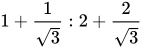
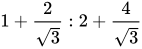

| Rhombitrihexagonal | Truncated Hexagonal | Truncated Trihexagonal |
|---|---|---|
Related tilings
Sources and credits
This article is adapted from the Wikipedia article “Snub trihexagonal tiling”, written by its contributors and licensed under CC BY-SA 4.0. Fathomly has changed the layout, removed citation markers, navigation and maintenance notices, and adjusted punctuation. This adapted version is shared under the same license. For references, see the original article.
Images, from Wikimedia Commons:
- Tiling snub 3-6 left simple.svg by Watchduck You can name the author as "T. Piesk", "Tilman Piesk" or "Watchduck"., CC BY 4.0
- 2-Uniform Tiling 20 Colored by Regular Polygon Orbits.svg by Harry Princeton, CC BY-SA 4.0
Fathomly is not affiliated with or endorsed by the Wikimedia Foundation. Spotted a problem? Tell us.

