Skolem normal form
Formalism of first-order logic
In mathematical logic, a formula of first-order logic is in Skolem normal form if it is in prenex normal form with only universal first-order quantifiers.
Every first-order formula may be converted into Skolem normal form while not changing its satisfiability via a process called Skolemization (sometimes spelled Skolemnization). The resulting formula is not necessarily equivalent to the original one, but is equisatisfiable with it: it is satisfiable if and only if the original one is satisfiable.
Reduction to Skolem normal form is a method for removing existential quantifiers from formal logic statements, often performed as the first step in an automated theorem prover.
01Examples
The simplest form of Skolemization is for existentially quantified variables that are not inside the scope of a universal quantifier. These may be replaced simply by creating new constants. For example, 


More generally, Skolemization is performed by replacing every existentially quantified variable 
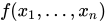


As an example, the formula 




02How Skolemization works
Skolemization works by applying a second-order equivalence together with the definition of first-order satisfiability. The equivalence provides a way for "moving" an existential quantifier before a universal one.

where
Intuitively, the sentence "for every 

This equivalence is useful because the definition of first-order satisfiability implicitly existentially quantifies over functions interpreting the function symbols. In particular, a first-order formula 


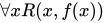


At the meta-level, first-order satisfiability of a formula 


Correctness of Skolemization may be shown on the example formula 







03Uses of Skolemization
One of the uses of Skolemization is within automated theorem proving. For example, in the method of analytic tableaux, whenever a formula whose leading quantifier is existential occurs, the formula obtained by removing that quantifier via Skolemization may be generated. For example, if 



This form of Skolemization is an improvement over "classical" Skolemization in that only variables that are free in the formula are placed in the Skolem term. This is an improvement because the semantics of tableaux may implicitly place the formula in the scope of some universally quantified variables that are not in the formula itself; these variables are not in the Skolem term, while they would be there according to the original definition of Skolemization. Another improvement that may be used is applying the same Skolem function symbol for formulae that are identical up to variable renaming.
Another use is in the resolution method for first-order logic, where formulas are represented as sets of clauses understood to be universally quantified. (For an example see drinker paradox.)
An important result in model theory is the Löwenheim-Skolem theorem, which can be proven via Skolemizing the theory and closing under the resulting Skolem functions.
04Skolem theories
In general, if 


Every Skolem theory is model complete, i.e. every substructure of a model is an elementary substructure. Given a model M of a Skolem theory T, the smallest substructure of M containing a certain set A is called the Skolem hull of A. The Skolem hull of A is an atomic prime model over A.
05History
Skolem normal form is named after the late Norwegian mathematician Thoralf Skolem.
Sources and credits
This article is adapted from the Wikipedia article “Skolem normal form”, written by its contributors and licensed under CC BY-SA 4.0. Fathomly has changed the layout, removed citation markers, navigation and maintenance notices, and adjusted punctuation. This adapted version is shared under the same license. For references, see the original article.
Fathomly is not affiliated with or endorsed by the Wikimedia Foundation. Spotted a problem? Tell us.