Reference articles on history, science, culture and more
Encyclopedia

Simplicial map

A simplicial map (also called simplicial mapping) is a function between two simplicial complexes, with the property that the images of the vertices of a simplex always span a simplex. Simplicial maps can be used to approximate continuous functions between topological spaces that can be triangulated; this is formalized by the simplicial approximation theorem.

A simplicial isomorphism is a bijective simplicial map such that both it and its inverse are simplicial.

01Definitions

A simplicial map is defined in slightly different ways in different contexts.

Abstract simplicial complexes

Let K and L be two abstract simplicial complexes (ASC). A simplicial map of K into L is a function from the vertices of K to the vertices of L, f:V(K)\to V(L), that maps every simplex in K to a simplex in L. That is, for any \sigma \in K, f(\sigma )\in L. As an example, let K be the ASC containing the sets {1,2},{2,3},{3,1} and their subsets, and let L be the ASC containing the set {4,5,6} and its subsets. Define a mapping f by: f(1)=f(2)=4, f(3)=5. Then f is a simplicial mapping, since f({1,2})={4} which is a simplex in L, f({2,3})=f({3,1})={4,5} which is also a simplex in L, etc.

If f is not bijective, it may map k-dimensional simplices in K to l-dimensional simplices in L, for any lk. In the above example, f maps the one-dimensional simplex {1,2} to the zero-dimensional simplex {4}.

If f is bijective, and its inverse f^{-1} is a simplicial map of L into K, then f is called a simplicial isomorphism. Isomorphic simplicial complexes are essentially "the same", up to a renaming of the vertices. The existence of an isomorphism between L and K is usually denoted by K\cong L. The function f defined above is not an isomorphism since it is not bijective. If we modify the definition to f(1)=4, f(2)=5, f(3)=6, then f is bijective but it is still not an isomorphism, since f^{-1} is not simplicial: f^{-1}(\{4,5,6\})=\{1,2,3\}, which is not a simplex in K. If we modify L by removing {4,5,6}, that is, L is the ASC containing only the sets {4,5},{5,6},{6,4} and their subsets, then f is an isomorphism.

Geometric simplicial complexes

Let K and L be two geometric simplicial complexes (GSC). A simplicial map of K into L is a function f:K\to L such that the images of the vertices of a simplex in K span a simplex in L. That is, for any simplex \sigma \in K, \operatorname {conv} (f(V(\sigma )))\in L. Note that this implies that vertices of K are mapped to vertices of L.

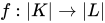
Equivalently, one can define a simplicial map as a function from the underlying space of K (the union of simplices in K) to the underlying space of L, f:|K|\to |L|, that maps every simplex in K linearly to a simplex in L. That is, for any simplex \sigma \in K, f(\sigma )\in L, and in addition, f\vert _{\sigma } (the restriction of f to \sigma) is a linear function. Every simplicial map is continuous.
Simplicial maps are determined by their effects on vertices. In particular, there are a finite number of simplicial maps between two given finite simplicial complexes.

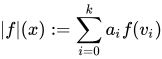
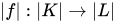
A simplicial map between two ASCs induces a simplicial map between their geometric realizations (their underlying polyhedra) using barycentric coordinates. This can be defined precisely. Let K, L be two ASCs, and let f:V(K)\to V(L) be a simplicial map. The affine extension of f is a mapping |f|:|K|\to |L| defined as follows. For any point x\in |K|, let \sigma be its support (the unique simplex containing x in its interior), and denote the vertices of \sigma by v_{0},\ldots ,v_{k}. The point x has a unique representation as a convex combination of the vertices, x=\sum _{i=0}^{k}a_{i}v_{i} with a_{i}\geq 0 and \sum _{i=0}^{k}a_{i}=1 (the a_{i} are the barycentric coordinates of x). We define |f|(x):=\sum _{i=0}^{k}a_{i}f(v_{i}). This |f| is a simplicial map of |K| into |L|; it is a continuous function. If f is injective, then |f| is injective; if f is an isomorphism between K and L, then |f| is a homeomorphism between |K| and |L|.
02Simplicial approximation

Let f\colon |K|\to |L| be a continuous map between the underlying polyhedra of simplicial complexes and let us write {\text{st}}(v) for the star of a vertex. A simplicial map f_{\triangle }\colon K\to L such that f({\text{st}}(v))\subseteq {\text{st}}(f_{\triangle }(v)), is called a simplicial approximation to f.

A simplicial approximation is homotopic to the map it approximates. See simplicial approximation theorem for more details.

03Piecewise-linear maps

Let K and L be two GSCs. A function f:|K|\to |L| is called piecewise-linear (PL) if there exist a subdivision K' of K, and a subdivision L' of L, such that f:|K'|\to |L'| is a simplicial map of K' into L'. Every simplicial map is PL, but the opposite is not true. For example, suppose |K| and |L| are two triangles, and let f:|K|\to |L| be a non-linear function that maps the leftmost half of |K| linearly into the leftmost half of |L|, and maps the rightmost half of |K| linearly into the rightmost half of |L|. Then f is PL, since it is a simplicial map between a subdivision of |K| into two triangles and a subdivision of |L| into two triangles. This notion is an adaptation of the general notion of a piecewise-linear function to simplicial complexes.
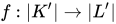
A PL homeomorphism between two polyhedra |K| and |L| is a PL mapping such that the simplicial mapping between the subdivisions, f:|K'|\to |L'|, is a homeomorphism.

Watch videos about Simplicial mapExplainers and documentaries on YouTube (opens in a new tab)

Sources and credits

This article is adapted from the Wikipedia article Simplicial map, written by its contributors and licensed under CC BY-SA 4.0. Fathomly has changed the layout, removed citation markers, navigation and maintenance notices, and adjusted punctuation. This adapted version is shared under the same license. For references, see the original article.

Fathomly is not affiliated with or endorsed by the Wikimedia Foundation. Spotted a problem? Tell us.