Reference articles on history, science, culture and more
Encyclopedia

Signature operator

In mathematics, the signature operator is an elliptic differential operator defined on a certain subspace of the space of differential forms on an even-dimensional compact Riemannian manifold, whose analytic index is the same as the topological signature of the manifold if the dimension of the manifold is a multiple of four. It is an instance of a Dirac-type operator.

01Definition in the even-dimensional case

Let M be a compact Riemannian manifold of even dimension 2l. Let

d:\Omega ^{p}(M)\rightarrow \Omega ^{p+1}(M)

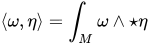
be the exterior derivative on i-th order differential forms on M. The Riemannian metric on M allows us to define the Hodge star operator \star and with it the inner product

\langle \omega ,\eta \rangle =\int _{M}\omega \wedge \star \eta

on forms. Denote by

d^{*}:\Omega ^{p+1}(M)\rightarrow \Omega ^{p}(M)

the adjoint operator of the exterior differential d. This operator can be expressed purely in terms of the Hodge star operator as follows:

d^{*}=(-1)^{2l(p+1)+2l+1}\star d\star =-\star d\star

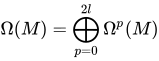
Now consider d+d^{*} acting on the space of all forms \Omega (M)=\bigoplus _{p=0}^{2l}\Omega ^{p}(M). One way to consider this as a graded operator is the following: Let \tau be an involution on the space of all forms defined by:

\tau (\omega )=i^{p(p-1)+l}\star \omega \quad ,\quad \omega \in \Omega ^{p}(M)

It is verified that d+d^{*} anti-commutes with \tau and, consequently, switches the (\pm 1)-eigenspaces \Omega _{\pm }(M) of \tau

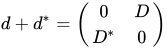
Consequently,

d+d^{*}={\begin{pmatrix}0&D\\D^{*}&0\end{pmatrix}}

Definition: The operator d+d^{*} with the above grading respectively the above operator D:\Omega _{+}(M)\rightarrow \Omega _{-}(M) is called the signature operator of M.

02Definition in the odd-dimensional case

In the odd-dimensional case one defines the signature operator to be i(d+d^{*})\tau acting on the even-dimensional forms of M.

03Hirzebruch Signature Theorem

If l=2k, so that the dimension of M is a multiple of four, then Hodge theory implies that:

\mathrm {index} (D)=\mathrm {sign} (M)

where the right hand side is the topological signature (i.e. the signature of a quadratic form on H^{2k}(M)\ defined by the cup product).

The Heat Equation approach to the Atiyah-Singer index theorem can then be used to show that:
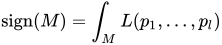
\mathrm {sign} (M)=\int _{M}L(p_{1},\ldots ,p_{l})

where L is the Hirzebruch L-Polynomial, and the p_{i}\ the Pontrjagin forms on M.

04Homotopy invariance of the higher indices

Kaminker and Miller proved that the higher indices of the signature operator are homotopy-invariant.

Watch videos about Signature operatorExplainers and documentaries on YouTube (opens in a new tab)

Sources and credits

This article is adapted from the Wikipedia article Signature operator, written by its contributors and licensed under CC BY-SA 4.0. Fathomly has changed the layout, removed citation markers, navigation and maintenance notices, and adjusted punctuation. This adapted version is shared under the same license. For references, see the original article.

Fathomly is not affiliated with or endorsed by the Wikimedia Foundation. Spotted a problem? Tell us.