Settling time
Time required for the output of an amplifier to stabilize

In control theory, the settling time of a dynamical system, such as an amplifier or other output device, is the time elapsed from the application of an ideal instantaneous step input to the time at which the amplifier output has entered and remained within a specified error band.
Settling time includes a propagation delay, plus the time required for the output to slew to the vicinity of the final value, recover from the overload condition associated with slew, and finally settle to within the specified error.
Systems with energy storage cannot respond instantaneously and will exhibit transient responses when they are subjected to inputs or disturbances.
01Definition
Tay, Mareels and Moore (1998) defined settling time as "the time required for the response curve to reach and stay within a range of certain percentage (usually 5% or 2%) of the final value."
02Mathematical detail
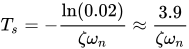
Settling time depends on the system response and natural frequency.
The settling time for a second order, underdamped system with natural frequency 


A general form is

Thus, if the damping ratio
Sources and credits
This article is adapted from the Wikipedia article “Settling time”, written by its contributors and licensed under CC BY-SA 4.0. Fathomly has changed the layout, removed citation markers, navigation and maintenance notices, and adjusted punctuation. This adapted version is shared under the same license. For references, see the original article.
Images, from Wikimedia Commons:
- High accuracy settling time measurements figure 1.png by Original Howard K. Schoenwetter. Traced by Sagsaw, Public domain
Fathomly is not affiliated with or endorsed by the Wikimedia Foundation. Spotted a problem? Tell us.