Complement (set theory)
Set of the elements not in a given subset

In set theory, the complement of a set A, often denoted by 
When all elements in the universe, i.e. all elements under consideration, are considered to be members of a given set U, the absolute complement of A is the set of elements in U that are not in A.
The relative complement of A with respect to a set B, also termed the set difference of B and A, written 
01Absolute complement
Definition
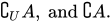
If A is a set, then the absolute complement of A (or simply the complement of A) is the set of elements not in A (within a larger set that is implicitly defined). In other words, let U be a set that contains all the elements under study; if there is no need to mention U, either because it has been previously specified, or it is obvious and unique, then the absolute complement of A is the relative complement of A in U:

The absolute complement of A is usually denoted by 

Examples
- Assume that the universe is the set of integers. If A is the set of odd numbers, then the complement of A is the set of even numbers. If B is the set of multiples of 3, then the complement of B is the set of numbers congruent to 1 or 2 modulo 3 (or, in simpler terms, the integers that are not multiples of 3).
- Assume that the universe is the standard 52-card deck. If the set A is the suit of spades, then the complement of A is the union of the suits of clubs, diamonds, and hearts. If the set B is the union of the suits of clubs and diamonds, then the complement of B is the union of the suits of hearts and spades.
- When the universe is the universe of sets described in formalized set theory, the absolute complement of a set is generally not itself a set, but rather a proper class. For more info, see universal set.
Properties
Let A and B be two sets in a universe U. The following identities capture important properties of absolute complements:


Complement laws:
- (this follows from the equivalence of a conditional with its contrapositive).




Involution or double complement law:

Relationships between relative and absolute complements:


Relationship with a set difference:

The first two complement laws above show that if A is a non-empty, proper subset of U, then {A, A∁} is a partition of U.

02Relative complement
Definition
If A and B are sets, then the relative complement of A in B, also termed the set difference of B and A, is the set of elements in B but not in A.
The relative complement of A in B is denoted 


Formally:

Examples
- If
is the set of real numbers and
is the set of rational numbers, then
is the set of irrational numbers.


Properties
Let A, B, and C be three sets in a universe U. The following identities capture notable properties of relative complements:
- with the important special case
demonstrating that intersection can be expressed using only the relative complement operation.
- with the important special case
- If
, then
.
is equivalent to
.







03Complementary relation
A binary relation 





Together with composition of relations and converse relations, complementary relations and the algebra of sets are the elementary operations of the calculus of relations.

04LaTeX notation
In the LaTeX typesetting language, the command \setminus is usually used for rendering a set difference symbol, which is similar to a backslash symbol. When rendered, the \setminus command looks identical to \backslash, except that it has a little more space in front and behind the slash, akin to the LaTeX sequence \mathbin{\backslash}. A variant \smallsetminus is available in the amssymb package, but this symbol is not included separately in Unicode. The symbol 

Sources and credits
This article is adapted from the Wikipedia article “Complement (set theory)”, written by its contributors and licensed under CC BY-SA 4.0. Fathomly has changed the layout, removed citation markers, navigation and maintenance notices, and adjusted punctuation. This adapted version is shared under the same license. For references, see the original article.
Images, from Wikimedia Commons:
- Venn01.svg by Watchduck You can name the author as "T. Piesk", "Tilman Piesk" or "Watchduck"., Public domain
- Venn10.svg by Watchduck You can name the author as "T. Piesk", "Tilman Piesk" or "Watchduck"., Public domain
- Relative compliment.svg by Patilvarad, CC BY-SA 4.0
Fathomly is not affiliated with or endorsed by the Wikimedia Foundation. Spotted a problem? Tell us.
