Reference articles on history, science, culture and more
Encyclopedia

Self-diffusion

Mass diffusivity of a chemical species without a chemical potential gradient

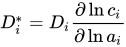
Self-diffusion describes the diffusive motions of molecules within themselves e.g. the movement of a water molecule in water. According to the IUPAC definition, the self-diffusion coefficient D_{i}^{*} of medium i is the diffusion coefficient D_{i} of a chemical species in said medium when the concentration of this species is extrapolated to zero concentration. It can be described by the equation:

D_{i}^{*}=D_{i}{\frac {\partial \ln c_{i}}{\partial \ln a_{i}}}

Here, a_{i} is the activity of the medium i (e.g. water) in the system (e.g. solution) and c_{i} is the concentration of medium i. Due to challenges observing it directly it is commonly assumed to be equal to the diffusion of an isotopically different molecule of the medium in the medium of interest e.g. a molecule of deuterated water in water. However modern simulations are able to estimate it directly without the need for isotope labeling.

Watch videos about Self-diffusionExplainers and documentaries on YouTube (opens in a new tab)

Sources and credits

This article is adapted from the Wikipedia article Self-diffusion, written by its contributors and licensed under CC BY-SA 4.0. Fathomly has changed the layout, removed citation markers, navigation and maintenance notices, and adjusted punctuation. This adapted version is shared under the same license. For references, see the original article.

Fathomly is not affiliated with or endorsed by the Wikimedia Foundation. Spotted a problem? Tell us.