Samuelson's inequality
Concept in statistics

In statistics, Samuelson's inequality, named after the economist Paul Samuelson, also called the Laguerre, Samuelson inequality, after the mathematician Edmond Laguerre, states that every one of any collection x1, ..., xn, is within √n − 1 uncorrected sample standard deviations of their sample mean.
01Statement of the inequality
If we let
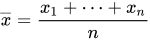
be the sample mean and

be the standard deviation of the sample, then

Equality holds on the left (or right) for 


If you instead define 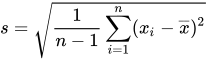


02Comparison to Chebyshev's inequality
Chebyshev's inequality locates a certain fraction of the data within certain bounds, while Samuelson's inequality locates all the data points within certain bounds.
The bounds given by Chebyshev's inequality are unaffected by the number of data points, while for Samuelson's inequality the bounds loosen as the sample size increases. Thus for large enough data sets, Chebyshev's inequality is more useful.
03Applications
Samuelson’s inequality has several applications in statistics and mathematics. It is useful in the studentization of residuals which shows a rationale for why this process should be done externally to better understand the spread of residuals in regression analysis.
In matrix theory, Samuelson’s inequality is used to locate the eigenvalues of certain matrices and tensors.
Furthermore, generalizations of this inequality apply to complex data and random variables in a probability space.
04Relationship to polynomials
Samuelson was not the first to describe this relationship: the first was probably Laguerre in 1880 while investigating the roots (zeros) of polynomials.
Consider a polynomial with all roots real:

Without loss of generality let 
and

Then

and

In terms of the coefficients
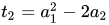
Laguerre showed that the roots of this polynomial were bounded by

where
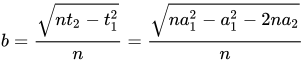
Inspection shows that 
Laguerre failed to notice this relationship with the means and standard deviations of the roots, being more interested in the bounds themselves. This relationship permits a rapid estimate of the bounds of the roots and may be of use in their location.
When the coefficients 

Sources and credits
This article is adapted from the Wikipedia article “Samuelson's inequality”, written by its contributors and licensed under CC BY-SA 4.0. Fathomly has changed the layout, removed citation markers, navigation and maintenance notices, and adjusted punctuation. This adapted version is shared under the same license. For references, see the original article.
Images, from Wikimedia Commons:
- Paul Samuelson.jpg by Paul_Samuelson.gif: Innovation & Business Architectures, Inc. derivative work: Bender235 (talk), CC BY 1.0
Fathomly is not affiliated with or endorsed by the Wikimedia Foundation. Spotted a problem? Tell us.