Sample entropy
Modification of approximate entropy
Sample entropy (SampEn; more appropriately K_2 entropy or Takens-Grassberger-Procaccia correlation entropy ) is a modification of approximate entropy (ApEn; more appropriately "Procaccia-Cohen entropy"), used for assessing the complexity of physiological and other time-series signals, diagnosing e.g. diseased states. SampEn has two advantages over ApEn: data length independence and a relatively trouble-free implementation. Also, there is a small computational difference: In ApEn, the comparison between the template vector (see below) and the rest of the vectors also includes comparison with itself. This guarantees that probabilities 
SampEn is indeed identical to the "correlation entropy" K_2 of Grassberger & Procaccia, except that it is suggested in the latter that certain limits should be taken in order to achieve a result invariant under changes of variables. No such limits and no invariance properties are considered in SampEn.
There is a multiscale version of SampEn as well, suggested by Costa and others. SampEn can be used in biomedical and biomechanical research, for example to evaluate postural control.
01Definition
Like approximate entropy (ApEn), Sample entropy (SampEn) is a measure of complexity. But it does not include self-similar patterns as ApEn does. For a given embedding dimension 





Now assume we have a time-series data set of length 

![d[X_{m}(i),X_{m}(j)]](https://wikimedia.org/api/rest_v1/media/math/render/svg/93e4fb022426932031f841501f30e7bfe9a47c77)
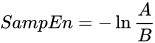
Where

![d[X_{m+1}(i),X_{m+1}(j)]<r](https://wikimedia.org/api/rest_v1/media/math/render/svg/91093efd51cc8a676f3d136b1bf136355235ae9a)

![d[X_{m}(i),X_{m}(j)]<r](https://wikimedia.org/api/rest_v1/media/math/render/svg/18d95c4475e23b29865a8f1bc27d90e3ebe362e8)
It is clear from the definition that 

Generally we take the value of 

02Multiscale SampEn
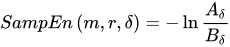
The definition mentioned above is a special case of multi scale sampEn with 




03Implementation
Sample entropy can be implemented easily in many different programming languages. Below lies an example written in Python.
from itertools import combinations from math import log def construct_templates(timeseries_data: list, m: int = 2): num_windows = len(timeseries_data) - m + 1 return [timeseries_data[x : x + m] for x in range(0, num_windows)] def get_matches(templates: list, r: float) -> int: return len( list(filter(lambda x: is_match(x[0], x[1], r), combinations(templates, 2))) ) def is_match(template_1: list, template_2: list, r: float) -> bool: return all([abs(x - y) < r for (x, y) in zip(template_1, template_2)]) def sample_entropy(timeseries_data: list, window_size: int, r: float): B = get_matches(construct_templates(timeseries_data, window_size), r) A = get_matches(construct_templates(timeseries_data, window_size + 1), r) return -log(A / B)An equivalent example in numerical Python.
import numpy def construct_templates(timeseries_data, m): num_windows = len(timeseries_data) - m + 1 return numpy.array([timeseries_data[x : x + m] for x in range(0, num_windows)]) def get_matches(templates, r) -> int: return len( list(filter(lambda x: is_match(x[0], x[1], r), combinations(templates))) ) def combinations(x): idx = numpy.stack(numpy.triu_indices(len(x), k=1), axis=-1) return x[idx] def is_match(template_1, template_2, r) -> bool: return numpy.all([abs(x - y) < r for (x, y) in zip(template_1, template_2)]) def sample_entropy(timeseries_data, window_size, r): B = get_matches(construct_templates(timeseries_data, window_size), r) A = get_matches(construct_templates(timeseries_data, window_size + 1), r) return -numpy.log(A / B)An example written in other languages can be found:
Sources and credits
This article is adapted from the Wikipedia article “Sample entropy”, written by its contributors and licensed under CC BY-SA 4.0. Fathomly has changed the layout, removed citation markers, navigation and maintenance notices, and adjusted punctuation. This adapted version is shared under the same license. For references, see the original article.
Fathomly is not affiliated with or endorsed by the Wikimedia Foundation. Spotted a problem? Tell us.
