Salinon
Geometric shape

The salinon (meaning 'salt-cellar' in Greek) is a geometrical figure that consists of four semicircles. It was first introduced in the Book of Lemmas, a work attributed to Archimedes.
01Construction
Let A, D, E, and B be four points on a line in the plane, in that order, with AD = EB. Let O be the bisector of segment AB (and of DE). Draw semicircles above line AB with diameters AB, AD, and EB, and another semicircle below with diameter DE. A salinon is the figure bounded by these four semicircles.
02Properties
Area
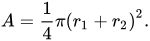
Archimedes introduced the salinon in his Book of Lemmas by applying Book II, Proposition 10 of Euclid's Elements. Archimedes noted that "the area of the figure bounded by the circumferences of all the semicircles [is] equal to the area of the circle on CF as diameter."
Namely, if 

Arbelos
Should points D and E converge with O, it would form an arbelos, another one of Archimedes' creations, with symmetry along the y-axis.
Sources and credits
This article is adapted from the Wikipedia article “Salinon”, written by its contributors and licensed under CC BY-SA 4.0. Fathomly has changed the layout, removed citation markers, navigation and maintenance notices, and adjusted punctuation. This adapted version is shared under the same license. For references, see the original article.
Images, from Wikimedia Commons:
- Salinon.svg by --pbroks13talk? The original uploader was Pbroks13 at English Wikipedia. New version by Rubber Duck (☮ • ✍), CC BY 3.0
Fathomly is not affiliated with or endorsed by the Wikimedia Foundation. Spotted a problem? Tell us.
