Second-order cone programming
Convex optimization problem
A second-order cone program (SOCP) is a convex optimization problem of the form
- minimize
- subject to


where the problem parameters are 


The name "second-order cone programming" comes from the nature of the individual constraints, which are each of the form:

These each define a subspace that is bounded by an inequality based on a second-order polynomial function defined on the optimization variable 
SOCPs can be solved by interior point methods and in general, can be solved more efficiently than semidefinite programming (SDP) problems. Some engineering applications of SOCP include filter design, antenna array weight design, truss design, and grasping force optimization in robotics. Applications in quantitative finance include portfolio optimization; some market impact constraints, because they are not linear, cannot be solved by quadratic programming but can be formulated as SOCP problems.
01Second-order cones
The standard or unit second-order cone of dimension 
.
The second-order cone is also known by the names quadratic cone, ice-cream cone, or Lorentz cone. For example, the standard second-order cone in 
.
The set of points satisfying a second-order cone constraint is the inverse image of the unit second-order cone under an affine mapping:

and hence is convex.
The second-order cone can be embedded in the cone of the positive semidefinite matrices since
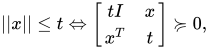
i.e., a second-order cone constraint is equivalent to a linear matrix inequality. The nomenclature here can be confusing; here 


which is not a linear inequality in the conventional sense.
Similarly, we also have,
.

02Relation with other optimization problems
When 


Convex quadratically constrained quadratic programs can also be formulated as SOCPs by reformulating the objective function as a constraint. Semidefinite programming subsumes SOCPs as the SOCP constraints can be written as linear matrix inequalities (LMI) and can be reformulated as an instance of semidefinite program. The converse, however, is not valid: there are positive semidefinite cones that do not admit any second-order cone representation.
Any closed convex semialgebraic set in the plane can be written as a feasible region of a SOCP. However, it is known that there exist convex semialgebraic sets of higher dimension that are not representable by SDPs; that is, there exist convex semialgebraic sets that can not be written as the feasible region of a SDP (nor, a fortiori, as the feasible region of a SOCP).
03Examples
Quadratic constraint
Consider a convex quadratic constraint of the form

This is equivalent to the SOCP constraint

Stochastic linear programming
Consider a stochastic linear program in inequality form
- minimize
- subject to


where the parameters 


- minimize
- subject to

where 
Stochastic second-order cone programming
We refer to second-order cone programs as deterministic second-order cone programs since data defining them are deterministic. Stochastic second-order cone programs are a class of optimization problems that are defined to handle uncertainty in data defining deterministic second-order cone programs.
Other examples
Other modeling examples are available at the MOSEK modeling cookbook.
04Solvers and scripting (programming) languages
| Name | License | Brief info |
|---|---|---|
| ALGLIB | free/commercial | A dual-licensed C++/C#/Java/Python numerical analysis library with parallel SOCP solver. |
| AMPL | commercial | An algebraic modeling language with SOCP support |
| Artelys Knitro | commercial | |
| CPLEX | commercial | |
| FICO Xpress | commercial | |
| Gurobi Optimizer | commercial | |
| MATLAB | commercial | The coneprog function solves SOCP problems using an interior-point algorithm |
| MOSEK | commercial | parallel interior-point algorithm |
| NAG Numerical Library | commercial | General purpose numerical library with SOCP solver |
Sources and credits
This article is adapted from the Wikipedia article “Second-order cone programming”, written by its contributors and licensed under CC BY-SA 4.0. Fathomly has changed the layout, removed citation markers, navigation and maintenance notices, and adjusted punctuation. This adapted version is shared under the same license. For references, see the original article.
Images, from Wikimedia Commons:
- Hierarchy compact convex.png by Akshayka, CC BY-SA 4.0
Fathomly is not affiliated with or endorsed by the Wikimedia Foundation. Spotted a problem? Tell us.