Ruzzo-Tompa algorithm
The Ruzzo-Tompa algorithm or the RT algorithm is a linear-time algorithm for finding all non-overlapping, contiguous, maximal scoring subsequences in a sequence of real numbers. The Ruzzo-Tompa algorithm was proposed by Walter L. Ruzzo and Martin Tompa. This algorithm is an improvement over previously known quadratic time algorithms. The maximum scoring subsequence from the set produced by the algorithm is also a solution to the maximum subarray problem.
The Ruzzo-Tompa algorithm has applications in bioinformatics, web scraping, and information retrieval.
01Applications
Bioinformatics
The Ruzzo-Tompa algorithm has been used in Bioinformatics tools to study biological data. The problem of finding disjoint maximal subsequences is of practical importance in the analysis of DNA. Maximal subsequences algorithms have been used in the identification of transmembrane segments and the evaluation of sequence homology.
The algorithm is used in sequence alignment which is used as a method of identifying similar DNA, RNA, or protein sequences. Accounting for the ordering of pairs of high-scoring subsequences in two sequences creates better sequence alignments. This is because the biological model suggests that separate high-scoring subsequence pairs arise from insertions or deletions within a matching region. Requiring consistent ordering of high-scoring subsequence pairs increases their statistical significance.
Web scraping
The Ruzzo-Tompa algorithm is used in Web scraping to extract information from web pages. Pasternack and Roth proposed a method for extracting important blocks of text from HTML documents. The web pages are first tokenized and the score for each token is found using local, token-level classifiers. A modified version of the Ruzzo-Tompa algorithm is then used to find the k highest-valued subsequences of tokens. These subsequences are then used as predictions of important blocks of text in the article.
Information retrieval
The Ruzzo-Tompa algorithm has been used in Information retrieval search algorithms. Liang et al. proposed a data fusion method to combine the search results of several microblog search algorithms. In their method, the Ruzzo-Tompa algorithm is used to detect bursts of information.
02Problem definition
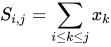
The problem of finding all maximal subsequences is defined as follows: Given a list of real numbered scores 
03Other algorithms
There are several approaches to solving the all maximal scoring subsequences problem. A natural approach is to use existing, linear time algorithms to find the maximum subsequence (see maximum subarray problem) and then recursively find the maximal subsequences to the left and right of the maximum subsequence. The analysis of this algorithm is similar to that of Quicksort: The maximum subsequence could be small in comparison to the rest of sequence, leading to a running time of 
04Algorithm
The standard implementation of the Ruzzo-Tompa algorithm runs in 
- Read the scores left to right and maintain the cumulative sum of the scores read. Maintain an ordered list
of disjoint subsequences. For each subsequence
, record the cumulative total
of all scores up to but not including the leftmost score of
up to and including the rightmost score of
- The lists are initially empty. Scores are read from left to right and are processed as follows. Nonpositive scores require no special processing, so the next score is read. A positive score is incorporated into a new sub-sequence
of length one that is then integrated into the list by the following process:
- The list
is searched from right to left for the maximum value of
satisfying
- If there is no such
- If there is such a
, then add
- Otherwise (i.e., there is such a j, but
), extend the subsequence
from the list, and append

- Once the end of the input is reached, all subsequences remaining on the list
The following Python code implements the Ruzzo-Tompa algorithm:
def ruzzo_tompa(scores): """Ruzzo-Tompa algorithm.""" k = 0 total = 0 # Allocating arrays of size n I, L, R, Lidx = [[0] * len(scores) for _ in range(4)] for i, s in enumerate(scores): total += s if s > 0: # store I[k] by (start,end) indices of scores I[k] = (i, i + 1) Lidx[k] = i L[k] = total - s R[k] = total while True: maxj = None for j in range(k - 1, -1, -1): if L[j] < L[k]: maxj = j break if maxj is not None and R[maxj] < R[k]: I[maxj] = (Lidx[maxj], i + 1) R[maxj] = total k = maxj else: k += 1 break # Getting maximal subsequences using stored indices return [scores[I[l][0] : I[l][1]] for l in range(k)]Sources and credits
This article is adapted from the Wikipedia article “Ruzzo-Tompa algorithm”, written by its contributors and licensed under CC BY-SA 4.0. Fathomly has changed the layout, removed citation markers, navigation and maintenance notices, and adjusted punctuation. This adapted version is shared under the same license. For references, see the original article.
Fathomly is not affiliated with or endorsed by the Wikimedia Foundation. Spotted a problem? Tell us.

