Resolution proof compression by splitting
In mathematical logic, proof compression by splitting is an algorithm that operates as a post-process on resolution proofs. It was proposed by Scott Cotton in his paper "Two Techniques for Minimizing Resolution Proof".
The Splitting algorithm is based on the following observation:
Given a proof of unsatisfiability 


Note that applying Splitting in a proof 



For achieving a better compression/time ratio, a heuristic for variable selection is desirable. For this purpose, Cotton defines the "additivity" of a resolution step (with antecedents 



Then, for each variable 

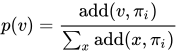
To split a proof of unsatisfiability 

Let 



Also, let 


Sources and credits
This article is adapted from the Wikipedia article “Resolution proof compression by splitting”, written by its contributors and licensed under CC BY-SA 4.0. Fathomly has changed the layout, removed citation markers, navigation and maintenance notices, and adjusted punctuation. This adapted version is shared under the same license. For references, see the original article.
Fathomly is not affiliated with or endorsed by the Wikimedia Foundation. Spotted a problem? Tell us.