Relaxed intersection
The relaxed intersection of m sets corresponds to the classical intersection between sets except that it is allowed to relax few sets in order to avoid an empty intersection. This notion can be used to solve constraints satisfaction problems that are inconsistent by relaxing a small number of constraints. When a bounded-error approach is considered for parameter estimation, the relaxed intersection makes it possible to be robust with respect to some outliers.
01Definition
The q-relaxed intersection of the m subsets


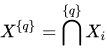


Define

We have
![X^{\{q\}}=\lambda ^{-1}([m-q,m]).](https://wikimedia.org/api/rest_v1/media/math/render/svg/1a061a3400e3891d6b2019b6f5577398e3af8766)
Characterizing the q-relaxed intersection is a thus a set inversion problem.

02Relaxed intersection of intervals
The relaxed intersection of intervals is not necessary an interval. We thus take
the interval hull of the result. If 
![X^{\{q\}}=\lambda ^{-1}([m-q,m])](https://wikimedia.org/api/rest_v1/media/math/render/svg/294b77be8504fee0a62cbc855b66de2badd9b759)
which corresponds to a union of intervals. We then return the smallest interval which contains this union.
Figure 2 shows the function


03Relaxed intersection of boxes
To compute the q-relaxed intersection of m boxes of
04Relaxed union
The q-relaxed union of
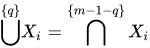
Note that when q=0, the relaxed union/intersection corresponds to the classical union/intersection. More precisely, we have
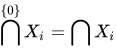
and
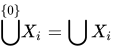

05De Morgan's law
If 
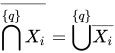
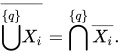
As a consequence
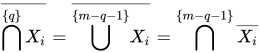
06Relaxation of contractors
Let 
![C([x])=\bigcap ^{\{q\}}C_{i}([x]).](https://wikimedia.org/api/rest_v1/media/math/render/svg/788587729f7e8ca9fb9fe1fdd1102cecdc2a0f1d)
is a contractor for 
![{\overline {C}}([x])=\bigcap ^{\{m-q-1\}}{\overline {C}}_{i}([x])](https://wikimedia.org/api/rest_v1/media/math/render/svg/d59a6070cd4b8efebd4b14a71f7d2d0497ae2d7b)
is a contractor for 

are contractors for
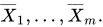
Combined with a branch-and-bound algorithm such as SIVIA (Set Inversion Via Interval Analysis), the q-relaxed
intersection of m subsets of

07Application to bounded-error estimation
The q-relaxed intersection can be used for robust localization or for tracking.
Robust observers can also be implemented using the relaxed intersections to be robust with respect to outliers.
We propose here a simple example to illustrate the method. Consider a model the ith model output of which is given by
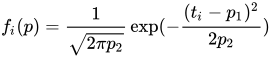
where 
![f_{i}(p)\in [y_{i}]](https://wikimedia.org/api/rest_v1/media/math/render/svg/64f73d68f14eabca9ecdda9f468cc96106ecc7bd)
where 
![[y_{i}]](https://wikimedia.org/api/rest_v1/media/math/render/svg/e0733aa435bd20b12b259b38350ab7b3e2bd2a9d)
![\{(1,[0;0.2]),(2,[0.3;2]),(3,[0.3;2]),(4,[0.1;0.2]),(5,[0.4;2]),(6,[-1;0.1])\}](https://wikimedia.org/api/rest_v1/media/math/render/svg/eefb2caf9e7b28cf4e0a7f3c3f7a3524bc186ba7)
The sets 
Sources and credits
This article is adapted from the Wikipedia article “Relaxed intersection”, written by its contributors and licensed under CC BY-SA 4.0. Fathomly has changed the layout, removed citation markers, navigation and maintenance notices, and adjusted punctuation. This adapted version is shared under the same license. For references, see the original article.
Images, from Wikimedia Commons:
- Wiki q inter def.jpg by Luc Jaulin, CC BY-SA 3.0
- Wiki qinter intervals.jpg by Luc Jaulin, CC BY-SA 3.0
- Wiki q inter 6box.jpg by Luc Jaulin, CC BY-SA 3.0
- Wiki qinter robab.jpg by Luc Jaulin, CC BY-SA 3.0
Fathomly is not affiliated with or endorsed by the Wikimedia Foundation. Spotted a problem? Tell us.