Rank error-correcting code
Error-correcting code
In coding theory, rank codes (also called Gabidulin codes) are non-binary linear error-correcting codes over not Hamming but rank metric. They described a systematic way of building codes that could detect and correct multiple random rank errors. By adding redundancy with coding k-symbol word to a n-symbol word, a rank code can correct any errors of rank up to t = ⌊ (d − 1) / 2 ⌋, where d is a code distance. As an erasure code, it can correct up to d − 1 known erasures.
A rank code is an algebraic linear code over the finite field 
The rank of the vector over 
The rank code corrects all errors with rank of the error vector not greater than t.
01Rank metric
Let 



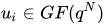

Every element 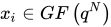


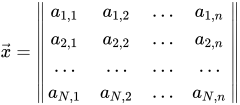
Rank of the vector 


The set of all vectors 


02Rank code
A set 



03Generating matrix
There are several known constructions of rank codes, which are maximum rank distance (or MRD) codes with d = n − k + 1. The easiest one to construct is known as the (generalized) Gabidulin code, it was discovered first by Delsarte (who called it a Singleton system) and later by Gabidulin (and Kshevetskiy ).
Let's define a Frobenius power ![[i]](https://wikimedia.org/api/rest_v1/media/math/render/svg/55a0ff71c93eedf2804d8495fbac7e3c1bed3bd0)

![x^{[i]}=x^{q^{i\mod N}}.\,](https://wikimedia.org/api/rest_v1/media/math/render/svg/ff4c22dd48c7ea11a5f1c8292fa7852fcf05a69e)
Then, every vector 
![G=\left\|{\begin{array}{*{20}c}g_{1}&g_{2}&\dots &g_{n}\\g_{1}^{[m]}&g_{2}^{[m]}&\dots &g_{n}^{[m]}\\g_{1}^{[2m]}&g_{2}^{[2m]}&\dots &g_{n}^{[2m]}\\\dots &\dots &\dots &\dots \\g_{1}^{[(k-1)m]}&g_{2}^{[(k-1)m]}&\dots &g_{n}^{[(k-1)m]}\end{array}}\right\|,](https://wikimedia.org/api/rest_v1/media/math/render/svg/7943a4ebefb1b3504af1642fee0ed660e216af4e)
where 
04Applications
There are several proposals for public-key cryptosystems based on rank codes. However, most of them have been proven insecure (see e.g. Journal of Cryptology, April 2008).
Rank codes are also useful for error and erasure correction in network coding.
Sources and credits
This article is adapted from the Wikipedia article “Rank error-correcting code”, written by its contributors and licensed under CC BY-SA 4.0. Fathomly has changed the layout, removed citation markers, navigation and maintenance notices, and adjusted punctuation. This adapted version is shared under the same license. For references, see the original article.
Fathomly is not affiliated with or endorsed by the Wikimedia Foundation. Spotted a problem? Tell us.
