Reference articles on history, science, culture and more
Encyclopedia

Range criterion

In quantum mechanics, in particular quantum information, the Range criterion is a necessary condition that a state must satisfy in order to be separable. In other words, it is a separability criterion.

01The result

Consider a quantum mechanical system composed of n subsystems. The state space H of such a system is the tensor product of those of the subsystems, i.e. H=H_{1}\otimes \cdots \otimes H_{n}.

For simplicity we will assume throughout that all relevant state spaces are finite-dimensional.

The criterion reads as follows: If ρ is a separable mixed state acting on H, then the range of ρ is spanned by a set of product vectors.

Proof

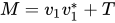
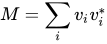
In general, if a matrix M is of the form M=\sum _{i}v_{i}v_{i}^{*}, the range of M, Ran(M), is contained in the linear span of \;\{v_{i}\}. On the other hand, we can also show v_{i} lies in Ran(M), for all i. Assume without loss of generality i = 1. We can write M=v_{1}v_{1}^{*}+T, where T is Hermitian and positive semidefinite. There are two possibilities:
1) span\{v_{1}\}\subsetKer(T). Clearly, in this case, v_{1}\in Ran(M).

2) Notice 1) is true if and only if Ker(T)\;^{\perp }\subset span\{v_{1}\}^{\perp }, where \perp denotes orthogonal complement. By Hermiticity of T, this is the same as Ran(T)\subset span\{v_{1}\}^{\perp }. So if 1) does not hold, the intersection Ran(T) \cap span\{v_{1}\} is nonempty, i.e. there exists some complex number α such that \;Tw=\alpha v_{1}. So

Mw=\langle w,v_{1}\rangle v_{1}+Tw=(\langle w,v_{1}\rangle +\alpha )v_{1}.

Therefore v_{1} lies in Ran(M).

Thus Ran(M) coincides with the linear span of \;\{v_{i}\}. The range criterion is a special case of this fact.

A density matrix ρ acting on H is separable if and only if it can be written as

\rho =\sum _{i}\psi _{1,i}\psi _{1,i}^{*}\otimes \cdots \otimes \psi _{n,i}\psi _{n,i}^{*}

where \psi _{j,i}\psi _{j,i}^{*} is a (un-normalized) pure state on the j-th subsystem. This is also

\rho =\sum _{i}(\psi _{1,i}\otimes \cdots \otimes \psi _{n,i})(\psi _{1,i}^{*}\otimes \cdots \otimes \psi _{n,i}^{*}).

But this is exactly the same form as M from above, with the vectorial product state \psi _{1,i}\otimes \cdots \otimes \psi _{n,i} replacing v_{i}. It then immediately follows that the range of ρ is the linear span of these product states. This proves the criterion.

Watch videos about Range criterionExplainers and documentaries on YouTube (opens in a new tab)

Sources and credits

This article is adapted from the Wikipedia article Range criterion, written by its contributors and licensed under CC BY-SA 4.0. Fathomly has changed the layout, removed citation markers, navigation and maintenance notices, and adjusted punctuation. This adapted version is shared under the same license. For references, see the original article.

Fathomly is not affiliated with or endorsed by the Wikimedia Foundation. Spotted a problem? Tell us.