Random effects model
Statistical model
In econometrics, a random effects model, also called a variance components model, is a statistical model where the model effects are random variables. It is a kind of hierarchical linear model, which assumes that the data being analysed are drawn from a hierarchy of different populations whose differences relate to that hierarchy. A random effects model is a special case of a mixed model.
Contrast this to the biostatistics definitions, as biostatisticians use "fixed" and "random" effects to respectively refer to the population-average and subject-specific effects (and where the latter are generally assumed to be unknown, latent variables).
01Qualitative description
Random effect models assist in controlling for unobserved heterogeneity when the heterogeneity is constant over time and not correlated with independent variables. Two common assumptions can be made about the individual specific effect: the random effects assumption and the fixed effects assumption. The random effects assumption is that the individual unobserved heterogeneity is uncorrelated with the independent variables. The fixed effect assumption is that the individual specific effect can be correlated with the independent variables.
If the random effects assumption holds, the random effects estimator is more efficient than the fixed effects model.
02Simple example
Suppose 


A simple way to model this variable is

where 
In this model 

The model can be augmented by including additional explanatory variables, which would capture differences in scores among different groups. For example:

where 

Variance components
The variance of 

Let
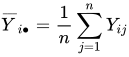
be the average, not of all scores at the
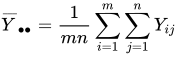
be the grand average.
Let
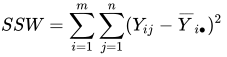
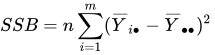
be respectively the sum of squares due to differences within groups and the sum of squares due to difference between groups. Then it can be shown that
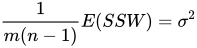
and
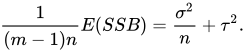
These "expected mean squares" can be used as the basis for estimation of the "variance components"
The
03Marginal likelihood
For random effects models the marginal likelihoods are important.
04Applications
Random effects models used in practice include the Bühlmann model of insurance contracts and the Fay-Herriot model used for small area estimation.
Sources and credits
This article is adapted from the Wikipedia article “Random effects model”, written by its contributors and licensed under CC BY-SA 4.0. Fathomly has changed the layout, removed citation markers, navigation and maintenance notices, and adjusted punctuation. This adapted version is shared under the same license. For references, see the original article.
Fathomly is not affiliated with or endorsed by the Wikimedia Foundation. Spotted a problem? Tell us.