Ramification group
Filtration of the Galois group of a local field extension
In number theory, more specifically in local class field theory, the ramification groups are a filtration of the Galois group of a local field extension, which gives detailed information on the ramification phenomena of the extension.
01Ramification theory of valuations
In mathematics, the ramification theory of valuations studies the set of extensions of a valuation v of a field K to an extension L of K. It is a generalization of the ramification theory of Dedekind domains.
The structure of the set of extensions is known better when L/K is Galois.
Decomposition group and inertia group
Let (K, v) be a valued field and let L be a finite Galois extension of K. Let Sv be the set of equivalence classes of extensions of v to L and let G be the Galois group of L over K. Then G acts on Sv by σ[w] = [w ∘ σ] (i.e. w is a representative of the equivalence class [w] ∈ Sv and [w] is sent to the equivalence class of the composition of w with the automorphism σ : L → L; this is independent of the choice of w in [w]). In fact, this action is transitive.
Given a fixed extension w of v to L, the decomposition group of w is the stabilizer subgroup Gw of [w], i.e. it is the subgroup of G consisting of all elements that fix the equivalence class [w] ∈ Sv.
Let mw denote the maximal ideal of w inside the valuation ring Rw of w. The inertia group of w is the subgroup Iw of Gw consisting of elements σ such that σx ≡ x (mod mw) for all x in Rw. In other words, Iw consists of the elements of the decomposition group that act trivially on the residue field of w. It is a normal subgroup of Gw.
The reduced ramification index e(w/v) is independent of w and is denoted e(v). Similarly, the relative degree f(w/v) is also independent of w and is denoted f(v).
02Ramification groups in lower numbering
Ramification groups are a refinement of the Galois group 


![{\mathcal {O}}_{L}={\mathcal {O}}_{K}[\alpha ]](https://wikimedia.org/api/rest_v1/media/math/render/svg/3ab2ad0e9c78bb318fb59d180ce0527188187c26)


- (i)
operates trivially on
- (ii)
for all
- (iii)



The group 

In fact, the 


The Galois group
where
are the (finite) residue fields of
.
is unramified.
is tamely ramified (i.e., the ramification index is prime to the residue characteristic.)
The study of ramification groups reduces to the totally ramified case since one has 

One also defines the function 





Fix a uniformizer 



is a product of cyclic groups of order
.
In particular,
The ramification groups can be used to compute the different 

If 

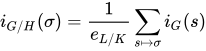
Combining this with the above one obtains: for a subextension 
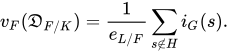
If 

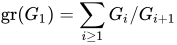
Example: the cyclotomic extension
The ramification groups for a cyclotomic extension 



where e is chosen such that 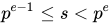
Example: a quartic extension
Let K be the extension of Q2 generated by 


A little computation shows that the quotient of any two of these is a unit. Hence they all generate the same ideal; call it π. 
Now 
and 
Various methods show that the Galois group of K is 

and



03Ramification groups in upper numbering
If 




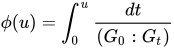
where, by convention, 
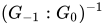



for all

(whereas lower numbering is compatible with passage to subgroups.)
Herbrand's theorem
Herbrand's theorem states that the ramification groups in the lower numbering satisfy 


The upper numbering for an abelian extension is important because of the Hasse-Arf theorem. It states that if 

The upper numbering is compatible with the filtration of the norm residue group by the unit groups under the Artin isomorphism. The image of 

is just

Sources and credits
This article is adapted from the Wikipedia article “Ramification group”, written by its contributors and licensed under CC BY-SA 4.0. Fathomly has changed the layout, removed citation markers, navigation and maintenance notices, and adjusted punctuation. This adapted version is shared under the same license. For references, see the original article.
Fathomly is not affiliated with or endorsed by the Wikimedia Foundation. Spotted a problem? Tell us.