Reference articles on history, science, culture and more
Encyclopedia

Radical axis

All points whose relative distances to two circles are same

Image credit is listed at the end of this article.

In Euclidean geometry, the radical axis of two non-concentric circles is the set of points whose powers with respect to the circles are equal. For this reason the radical axis is also called the power line or power bisector of the two circles. In detail:

For two circles c1, c2 with centers M1, M2 and radii r1, r2 respectively, the powers of a point P with respect to the circles are

\Pi _{1}(P)=|PM_{1}|^{2}-r_{1}^{2},\qquad \Pi _{2}(P)=|PM_{2}|^{2}-r_{2}^{2}.

Point P belongs to the radical axis, if

\Pi _{1}(P)=\Pi _{2}(P).

If the circles have two points in common, the radical axis is the common secant line of the circles.
If point P is outside the circles, P has equal tangential distance to the both circles.
If the radii are equal, the radical axis is the line segment bisector of M1, M2.
In any case the radical axis is a line perpendicular to {\overline {M_{1}M_{2}}}.

01On notations

The term radical axis was used by the French mathematician M. Chasles as axe radical.
J.V. Poncelet used the term chorde ideale.
J. Plücker introduced the term Chordale.
J. Steiner called the radical axis line of equal powers (German: Linie der gleichen Potenzen) which led to the term power line (Potenzgerade).

Definition and calculation of

02Properties

Geometric shape and its position

Let {\vec {x}},{\vec {m}}_{1},{\vec {m}}_{2} be the position vectors of the points P,M_{1},M_{2}. Then the defining equation of the radical line can be written as:

({\vec {x}}-{\vec {m}}_{1})^{2}-r_{1}^{2}=({\vec {x}}-{\vec {m}}_{2})^{2}-r_{2}^{2}\quad \leftrightarrow \quad 2{\vec {x}}\cdot ({\vec {m}}_{2}-{\vec {m}}_{1})+{\vec {m}}_{1}^{2}-{\vec {m}}_{2}^{2}+r_{2}^{2}-r_{1}^{2}=0

From the right equation one gets

  • The pointset of the radical axis is indeed a line and is perpendicular to the line through the circle centers.

({\vec {m}}_{2}-{\vec {m}}_{1} is a normal vector to the radical axis!)

Dividing the equation by 2|{\vec {m}}_{2}-{\vec {m}}_{1}|, one gets the Hessian normal form. Inserting the position vectors of the centers yields the distances of the centers to the radical axis:

d_{1}={\frac {d^{2}+{r_{1}}^{2}-{r_{2}}^{2}}{2d}}\ ,\qquad d_{2}={\frac {d^{2}+{r_{2}}^{2}-{r_{1}}^{2}}{2d}},
with d=|M_{1}M_{2}|=|{\vec {m}}_{2}-{\vec {m}}_{1}|.

(d_{i} may be negative if L is not between M_{1},M_{2}.)

If the circles are intersecting at two points, the radical line runs through the common points. If they only touch each other, the radical line is the common tangent line.

Special positions

  • The radical axis of two intersecting circles is their common secant line.
  • The radical axis of two touching circles is their common tangent.
  • The radical axis of two non intersecting circles is the common secant of two convenient equipotent circles (see below Orthogonal circles).

Orthogonal circles

  • For a point P in the exterior of a circle c_{i} and the two tangent points S_{i},T_{i} the equation |PS_{i}|^{2}=|PT_{i}|^{2}=\Pi _{i}(P) holds and S_{i},T_{i} lie on the circle c_{o} with center P and radius {\sqrt {\Pi _{i}(P)}}. The circle c_{o} intersects the circles c_{i} orthogonally. Hence:
If P is a point of the radical axis, then the four points S_{1},T_{1},S_{2},T_{2} lie on the circle c_{o}, which intersects the given circles c_{1},c_{2} orthogonally.
  • The radical axis consists of all centers of circles, which intersect the given circles orthogonally.
Radical axis: variations

03System of orthogonal circles

The method described in the previous section for the construction of a pencil of circles, which intersect two given circles orthogonally, can be extended to the construction of two orthogonally intersecting systems of circles:

Let c_{1},c_{2} be two apart lying circles (as in the previous section), M_{1},M_{2},r_{1},r_{2} their centers and radii respectively, and let g_{12} be their radical axis. Now, all the circles which have with c_{1} the line g_{12} as a radical axis will be determined with their centers on the line {\overline {M_{1}M_{2}}}. If \gamma _{2} is such a circle, whose center has distance \delta to the center M_{1} and radius \rho _{2}. From the result in the previous section one gets the equation

d_{1}={\frac {\delta ^{2}+r_{1}^{2}-\rho _{2}^{2}}{2\delta }},\quadwhere d_{1}>r_{1} are fixed.

With \delta _{2}=\delta -d_{1} the equation can be rewritten as:

\delta _{2}^{2}=d_{1}^{2}-r_{1}^{2}+\rho _{2}^{2}.

If the radius \rho _{2} is given, from this equation one finds the distance \delta _{2} to the (fixed) radical axis of the new center. On the diagram, the color of the new circles is purple. Any green circle has its center on the radical axis and intersects the circles c_{1},c_{2} orthogonally and hence all the new circles (the purple ones) too. Choosing the radical axis (the red line) as y-axis and line {\overline {M_{1}M_{2}}} as x-axis, the two pencils of circles have the equations:

purple: \ \ \ (x-\delta _{2})^{2}+y^{2}=\delta _{2}^{2}+r_{1}^{2}-d_{1}^{2}
green: \ x^{2}+(y-y_{g})^{2}=y_{g}^{2}+d_{1}^{2}-r_{1}^{2}\ .

(the point\;(0,y_{g}) is the center of a green circle.)

Properties:
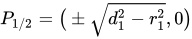
a) Any two green circles intersect on the x-axis at the points P_{1/2}={\big (}\pm {\sqrt {d_{1}^{2}-r_{1}^{2}}},0{\big )}, the poles of the orthogonal system of circles. That means, the x-axis is the radical axis of the green circles.
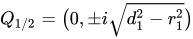
b) The purple circles have no points in common. But, if one considers the real plane as part of the complex plane, then any two purple circles intersect on the y-axis (their common radical axis) at the points Q_{1/2}={\big (}0,\pm i{\sqrt {d_{1}^{2}-r_{1}^{2}}}{\big )}.
Special cases:
a) In case of d_{1}=r_{1} the green circles are touching each other at the origin with the x-axis as common tangent and the purple circles have the y-axis as common tangent. Such a system of circles is called coaxal parabolic circles (see below).
b) Shrinking c_{1} to its center M_{1}, i.e. r_{1}=0, the equations turn take a simpler form and one gets M_{1}=P_{1}.

Conclusion:
a) For any real w the pencil of circles

\;c(\xi ):\;(x-\xi )^{2}+y^{2}-\xi ^{2}-w=0\ :
has the property: The y-axis is the radical axis of c(\xi _{1}),c(\xi _{2}).
In case of w>0 the circles c(\xi _{1}),c(\xi _{2}) intersect at points P_{1/2}=(0,\pm {\sqrt {w}}).
In case of w<0 they have no points in common.
In case of w=0 they touch at (0,0) and the y-axis is their common tangent.

b) For any real w the two pencils of circles

c_{1}(\xi ):\;(x-\xi )^{2}+y^{2}-\xi ^{2}-w=0\ ,
c_{2}(\eta ):\;x^{2}+(y-\eta )^{2}-\eta ^{2}+w=0\
form a system of orthogonal circles. That means: any two circles c_{1}(\xi ),c_{2}(\eta ) intersect orthogonally.

c) From the equations in b), one gets a coordinate free representation:

For the given points P_{1},P_{2}, their midpoint O and their line segment bisector g_{12} the two equations
|XM|^{2}=|OM|^{2}-|OP_{1}|^{2}\ ,
|XN|^{2}=|ON|^{2}+|OP_{1}|^{2}=|NP_{1}|^{2}with M on {\overline {P_{1}P_{2}}}, but not between P_{1},P_{2}, and N on g_{12}
describe the orthogonal system of circles uniquely determined by P_{1},P_{2} which are the poles of the system.
For P_{1}=P_{2}=O one has to prescribe the axes a_{1},a_{2} of the system. The system is parabolic:
|XM|^{2}=|OM|^{2}\ ,\quad |XN|^{2}=|ON|^{2} with M on a_{1} and N on a_{2}.

Straightedge and compass construction:

A system of orthogonal circles is determined uniquely by its poles P_{1},P_{2}:

  1. The axes (radical axes) are the lines {\overline {P_{1}P_{2}}} and the line segment bisector g_{12} of the poles.
  2. The circles (green in the diagram) through P_{1},P_{2} have their centers on g_{12}. They can be drawn easily. For a point N the radius is \;r_{N}=|NP_{1}|\;.
  3. In order to draw a circle of the second pencil (in diagram blue) with center M on {\overline {P_{1}P_{2}}}, one has to determine the radius r_{M} applying the theorem of Pythagoras: \;r_{M}^{2}=|OM|^{2}-|OP_{1}|^{2}\; (see diagram).

In case of P_{1}=P_{2} the axes have to be chosen additionally. The system is parabolic and can be drawn easily.

The touching points of the tangents through lie on the orthogonal circle (green)

04Coaxal circles

Definition and properties:

Let c_{1},c_{2} be two circles and \Pi _{1},\Pi _{2} their power functions. Then for any \lambda \neq 1

  • \Pi _{1}(x,y)-\lambda \Pi _{2}(x,y)=0

is the equation of a circle c(\lambda ) (see below). Such a class of circles is called the system of coaxal circles generated by the circles c_{1},c_{2}. (In the case \lambda =1 the equation describes the radical axis of c_{1},c_{2}.)

The power function of c(\lambda ) is

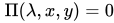
\ \Pi (\lambda ,x,y)={\frac {\Pi _{1}(x,y)-\lambda \Pi _{2}(x,y)}{1-\lambda }}.

The normed equation (the coefficients of x^{2},y^{2} are 1) of c(\lambda ) is \ \Pi (\lambda ,x,y)=0.

A simple calculation shows:

  • c(\lambda ),c(\mu ),\ \lambda \neq \mu \ , have the same radical axis as c_{1} and c_{2}.

Allowing \lambda to move to infinity, one can see that c_{1} and c_{2} are members of the system of coaxal circles: c_{1}=c(0),\;c_{2}=c(\infty ).

(E): If c_{1},c_{2} intersect at two points P_{1},P_{2}, then P_{1},P_{2} are points of any circle c(\lambda ), and the line {\overline {P_{1}P_{2}}} is their common radical axis. Such a system is called elliptic.
(P): If c_{1} and c_{2} are tangent at P, then any circle of the system is tangent to both c_{1} and c_{2} at point P. The common tangent is their common radical axis. Such a system is called parabolic.
(H): If c_{1} and c_{2} have no point in common, then the same is true for any pair of circles of the system. The radical axis of any pair of circles is the radical axis of c_{1} and c_{2}. This system is called hyperbolic.

In detail:

Introducing coordinates such that

c_{1}:(x-d_{1})^{2}+y^{2}=r_{1}^{2}
c_{2}:(x-d_{2})^{2}+y^{2}=d_{2}^{2}+r_{1}^{2}-d_{1}^{2},

then the y-axis is their radical axis (see above).

Calculating the power function \Pi (\lambda ,x,y) gives the normed circle equation:

c(\lambda ):\ x^{2}+y^{2}-2{\tfrac {d_{1}-\lambda d_{2}}{1-\lambda }}\;x+d_{1}^{2}-r_{1}^{2}=0\ .

Completing the square and substituting \delta _{2}={\tfrac {d_{1}-\lambda d_{2}}{1-\lambda }} (x-coordinate of the center) yields the centered form of the equation

c(\lambda ):\ (x-\delta _{2})^{2}+y^{2}=\delta _{2}^{2}+r_{1}^{2}-d_{1}^{2}.

When r_{1}>d_{1} the circles c_{1},c_{2},c(\lambda ) intersect at the two points

P_{1}={\big (}0,{\sqrt {r_{1}^{2}-d_{1}^{2}}}{\big )},\quad P_{2}={\big (}0,-{\sqrt {r_{1}^{2}-d_{1}^{2}}}{\big )}

and the system of coaxal circles is elliptic.

If r_{1}=d_{1}, the circles c_{1},c_{2},c(\lambda ) have the point P_{0}=(0,0) in common and the system is parabolic.

If r_{1}<d_{1}, the circles c_{1},c_{2},c(\lambda ) have no point in common and the system is hyperbolic.

Alternative equations:
1) In the defining equation of a coaxal system of circles there can be used multiples of the power functions, too.
2) The equation of one of the circles can be replaced by the equation of the desired radical axis. The radical axis can be seen as a circle with an infinitely large radius. For example:

(x-x_{1})^{2}+y^{2}-r_{1}^{2}\ -\ \lambda \;2(x-x_{2})\ =0\ \Leftrightarrow
(x-(x_{1}+\lambda ))^{2}+y^{2}=(x_{1}+\lambda )^{2}+r_{1}^{2}-x_{1}^{2}-2\lambda x_{2},

describes all circles, which have with the first circle the line x=x_{2} as radical axis.
3) In order to express the equal status of the two circles, the following form is often used:

\mu \Pi _{1}(x,y)+\nu \Pi _{2}(x,y)=0\;.

But in this case the representation of a circle by the parameters \mu ,\nu is not unique.

Applications:
a) Circle inversions and Möbius transformations preserve angles and generalized circles. Hence orthogonal systems of circles play an essential role with investigations on these mappings.
b) In electromagnetism coaxal circles appear as field lines.

System of orthogonal circles: construction

05Radical center of three circles, construction of the radical axis

For three circles c_{1},c_{2},c_{3}, no two of which are concentric, there are three radical axes g_{12},g_{23},g_{31}. If the centers of these circles are not collinear, their radical axes intersect in a common point R, the radical center of the three circles. The circle which is orthogonal to the two of the circles with center in R is orthogonal to the third circle (radical circle).

Proof. The radical axis g_{ik} contains all points which have equal tangential distance to the circles c_{i},c_{k}. The intersection point R of g_{12} and g_{23} has the same tangential distance to the all three circles. Hence, R is a point on the radical axis g_{31}, too.
This property allows one to construct the radical axis of two non intersecting circles c_{1},c_{2} with centers M_{1},M_{2}: Draw a third circle c_{3} with center not collinear to the given centers that intersects c_{1},c_{2}. The radical axes g_{13},g_{23} can be drawn. Their intersection point is the radical center R of the three circles and lies on g_{12}. The line through R which is perpendicular to {\overline {M_{1}M_{2}}} is the radical axis g_{12}.

Additional construction method:

All points which have the same power to a given circle c lie on a circle concentric to c. Let us call it an equipower circle. This property can be used for an additional construction method of the radical axis of two circles:

For two non intersecting circles c_{1},c_{2}, there can be drawn two equipower circles c'_{1},c'_{2}, which have the same power with respect to c_{1},c_{2} (see diagram). In detail: \Pi _{1}(P_{1})=\Pi _{2}(P_{2}). If the power is large enough, the circles c'_{1},c'_{2} have two points in common, which lie on the radical axis g_{12}.

Parabolic orthogonal system

06Relation to bipolar coordinates

In general, any two disjoint, non-concentric circles can be aligned with the circles of a system of bipolar coordinates. In that case, the radical axis is simply the y-axis of this system of coordinates. Every circle on the axis that passes through the two foci of the coordinate system intersects the two circles orthogonally. A maximal collection of circles, all having centers on a given line and all pairs having the same radical axis, is known as a pencil of coaxal circles.

Coaxal circles: types

07Radical center in trilinear coordinates

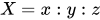
If the circles are represented in trilinear coordinates in the usual way, then their radical center is conveniently given as a certain determinant. Specifically, let X=x:y:z denote a variable point in the plane of a triangle ABC which has sides with lengths a=|BC|,b=|CA|,c=|AB|, and represent the circles as follows:
(dx+ey+fz)(ax+by+cz)+g(ayz+bzx+cxy)=0,
(hx+iy+jz)(ax+by+cz)+k(ayz+bzx+cxy)=0,
(lx+my+nz)(ax+by+cz)+p(ayz+bzx+cxy)=0.

Then the radical center is the point

{\begin{vmatrix}g&k&p\\e&i&m\\f&j&n\end{vmatrix}}:{\begin{vmatrix}g&k&p\\f&j&n\\d&h&l\end{vmatrix}}:{\begin{vmatrix}g&k&p\\d&h&l\\e&i&m\end{vmatrix}}.
Orthogonal system of circles to given poles

08Radical plane and hyperplane

The radical plane of two non-concentric spheres in three dimensions is defined similarly: it is the locus of points from which tangents to the two spheres have same lengths. The fact that this locus is a plane follows by rotation in the third dimension from the fact that the radical axis is a straight line.

The same definition can be applied to hyperspheres in Euclidean space of any dimension, giving the radical hyperplane of two non-concentric hyperspheres.

Watch videos about Radical axisExplainers and documentaries on YouTube (opens in a new tab)

Sources and credits

This article is adapted from the Wikipedia article Radical axis, written by its contributors and licensed under CC BY-SA 4.0. Fathomly has changed the layout, removed citation markers, navigation and maintenance notices, and adjusted punctuation. This adapted version is shared under the same license. For references, see the original article.

Images, from Wikimedia Commons:

Fathomly is not affiliated with or endorsed by the Wikimedia Foundation. Spotted a problem? Tell us.