RV coefficient
In statistics, the RV coefficient is a multivariate generalization of the squared Pearson correlation coefficient (because the RV coefficient takes values between 0 and 1). It measures the closeness of two set of points that may each be represented in a matrix.
The major approaches within statistical multivariate data analysis can all be brought into a common framework in which the RV coefficient is maximised subject to relevant constraints. Specifically, these statistical methodologies include:
One application of the RV coefficient is in functional neuroimaging where it can measure the similarity between two subjects' series of brain scans or between different scans of a same subject.
01Definitions
The definition of the RV-coefficient makes use of ideas concerning the definition of scalar-valued quantities which are called the "variance" and "covariance" of vector-valued random variables. Note that standard usage is to have matrices for the variances and covariances of vector random variables. Given these innovative definitions, the RV-coefficient is then just the correlation coefficient defined in the usual way.
Suppose that X and Y are matrices of centered random vectors (column vectors) with covariance matrix given by

then the scalar-valued covariance (denoted by COVV) is defined by

The scalar-valued variance is defined correspondingly:

With these definitions, the variance and covariance have certain additive properties in relation to the formation of new vector quantities by extending an existing vector with the elements of another.
Then the RV-coefficient is defined by

02Shortcoming of the coefficient and adjusted version
Even though the coefficient takes values between 0 and 1 by construction, it seldom attains values close to 1 as the denominator is often too large with respect to the maximal attainable value of the denominator.
Given known diagonal blocks 


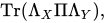


In light of this, Mordant and Segers proposed an adjusted version of the RV coefficient in which the denominator is the maximal value attainable by the numerator. It reads

The impact of this adjustment is clearly visible in practice.
Sources and credits
This article is adapted from the Wikipedia article “RV coefficient”, written by its contributors and licensed under CC BY-SA 4.0. Fathomly has changed the layout, removed citation markers, navigation and maintenance notices, and adjusted punctuation. This adapted version is shared under the same license. For references, see the original article.
Fathomly is not affiliated with or endorsed by the Wikimedia Foundation. Spotted a problem? Tell us.
