Projective representation
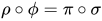
Map from algebra to geometric transforms
In the field of representation theory in mathematics, a projective representation of a group G on a vector space V over a field F is a group homomorphism from G to the projective linear group

where GL(V) is the general linear group of invertible linear transformations of V over F, and F∗ is the normal subgroup of
consisting of nonzero scalar multiples of the identity transformation (see Scalar transformation).
Just as linear representations study the possible actions of the group G on vector spaces via linear transformation, the projective representations study the actions on lines in these vector spaces (namely (V \{0}) / F*) via linear transformations.
In more concrete terms, a projective representation of can be represented as a collection of operators
satisfying the homomorphism property up to a constant:
for some constant . Two such choices of operators
define the same projective representation if for any
the choices
are the same up to a scalar. Equivalently, a projective representation of
is a collection of operators
, such that
. Note that, in this notation,
is a set of linear operators related by multiplication with some nonzero scalar.
If it is possible to choose a particular representative in each family of operators in such a way that the homomorphism property is satisfied exactly, rather than just up to a constant, then we say that
can be "de-projectivized", or that
can be "lifted to an ordinary representation". More concretely, we thus say that
can be de-projectivized if there are
for each
such that
. This possibility is discussed further below.
01Linear representations and projective representations
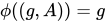
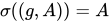
One way in which a projective representation can arise is by taking a linear group representation of G on V and applying the quotient map

which is the quotient by the subgroup F∗ of scalar transformations (diagonal matrices with all diagonal entries equal). The interest for algebra is in the process in the other direction: given a projective representation, try to 'lift' it to an ordinary linear representation. A general projective representation ρ: G → PGL(V) cannot be lifted to a linear representation G → GL(V), and the obstruction to this lifting can be understood via group cohomology, as described below.
However, one can lift a projective representation of G to a linear representation of a different group H, which will be a central extension of G. The group
is the subgroup of
defined as follows:
,
where is the quotient map of
onto
. Since
is a homomorphism, it is easy to check that
is, indeed, a subgroup of
. If the original projective representation
is faithful, then
is isomorphic to the preimage in
of
.
We can define a homomorphism by setting
. The kernel of
is:
,
which is contained in the center of . It is clear also that
is surjective, so that
is a central extension of
. We can also define an ordinary representation
of
by setting
. The ordinary representation
of
is a lift of the projective representation
of
in the sense that:
.
If G is a perfect group there is a single universal perfect central extension of G that can be used.
Group cohomology
The analysis of the lifting question involves group cohomology. Indeed, if one fixes for each g in G a lifted element L(g) in lifting from PGL(V) back to GL(V), the lifts then satisfy
for some scalar c(g,h) in F∗. It follows that the 2-cocycle or Schur multiplier c satisfies the cocycle equation

for all g, h, k in G. This c depends on the choice of the lift L; a different choice of lift L′(g) = f(g) L(g) will result in a different cocycle

cohomologous to c. Thus L defines a unique class in H2(G, F∗). This class might not be trivial. For example, in the case of the symmetric group and alternating group, Schur established that there is exactly one non-trivial class of Schur multiplier, and completely determined all the corresponding irreducible representations.
In general, a nontrivial class leads to an extension problem for G. If G is correctly extended we obtain a linear representation of the extended group, which induces the original projective representation when pushed back down to G. The solution is always a central extension. From Schur's lemma, it follows that the irreducible representations of central extensions of G, and the irreducible projective representations of G, are essentially the same objects.
02First example: Finite abelian groups
The group with 2 elements
Consider first the group with two elements denoted by
, where
is the trivial element and the group is defined by the identity
. In every projective representation
is sent to the identity map, so the representation is determined completely by the image of
. This group has two (irreducible) linear representations, both 1-dimensional:
- The trivial representation:
- The nontrivial representation:
While these are distinct as linear representations, namely their actions on the points are different, they are the same as projective representations. In a 1-dimensional space, there is a single line, and both send that line to itself. More generally, any choice of the image will produce the same 1-dimensional projective representation. Namely, there is a unique 1-dimensional projective representation, and it is the trivial representation (and this holds for any group).
Over the 2-dimensional plane , we can send
to the
rotation:
Two rotations, namely
rotation, returns the lines in the plane to themselves, hence it defines a projective representation. More formally,
are the same up to a sign:
Unlike the 1-dimensional case, this projective representation doesn't arise from a standard linear representation. However, working over the complex numbers instead of the real numbers, this projective representation is the same as
in which case it is a linear representation, since
.
General cyclic group
Now let which we write multiplicatively as
, and let
be a choice of representatives for a projective representation:
- The trivial element: Since
, and
is invertible, it must be the scalar
. Hence, we can change the choice to be
without changing the representation.
- The nontrivial elements: Since
are the same up to a scalar, we can similarly choose the representatives so that
for
.
After these reductions, we are left with a choice for and a scalar
such that
On the other hand, any choice of a root for some scalar
can define a projective representation by setting
Over the complex numbers (or generally over algebraically closed field), changing the choice of into
will produce a standard linear representation, or in other words all the projective representations arise from ordinary linear representations
Product of cyclic groups
In a product of two cyclic groups , a similar process can be done by changing the choice of representatives to satisfy:
This reduces to three conditions:
,
, and
.
This new scalar must satisfy:
, so that
.
- Similarly,
.
Both together imply that . Any such choices of
which satisfy these 3 conditions will define a projective representation.
Over the complex numbers, as previously we can assume that , so the only parameter is
.
For example, taking we have 3 conditions
and
where
. These equations have solutions in
for any
and any choice of root of unity
. More specifically, letting
be such a root of unity, define:
.
Both matrices define an "-rotation":
rotates each coordinate separately as complex numbers, while
rotates the coordinates of the vector, and in particular
. In addition we have that
.
Note that is independent of the choices of representatives. It follows that the
projective representations defined above for the
distinct roots of unity are distinct representations.
The projective representations for general product of cyclic groups is done in a similar manner.
03Discrete Fourier transform
The projective representations of as mentioned above, are many times viewed through the lens of Fourier transform.
Consider the field of integers mod
, where
is prime, and let
be the
-dimensional space of functions on
with values in
. For each
in
, define two operators,
and
on
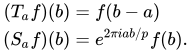
as follows:
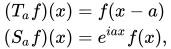
We write the formula for as if
and
were integers, but it is easily seen that the result only depends on the value of
and
mod
. The operator
is a translation, while
is a shift in frequency space (that is, it has the effect of translating the discrete Fourier transform of
).
One may easily verify that for any and
in
, the operators
and
commute up to multiplication by a constant:
.
We may therefore define a projective representation of
as follows:
,
where denotes the image of an operator
in the quotient group
. Since
and
commute up to a constant,
is easily seen to be a projective representation. On the other hand, since
and
do not actually commute, and no nonzero multiples of them will commute,
cannot be lifted to an ordinary (linear) representation of
.
Since the projective representation is faithful, the central extension
of
obtained by the construction in the previous section is just the preimage in
of the image of
. Explicitly, this means that
is the group of all operators of the form
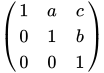
for . This group is a discrete version of the Heisenberg group and is isomorphic to the group of matrices of the form
with .
04Projective representations of Lie groups
Studying projective representations of Lie groups leads one to consider true representations of their central extensions (see Group extension § Lie groups). In many cases of interest it suffices to consider representations of covering groups. Specifically, suppose is a connected cover of a connected Lie group
, so that
for a discrete central subgroup
of
. (Note that
is a special sort of central extension of
.) Suppose also that
is an irreducible unitary representation of
(possibly infinite dimensional). Then by Schur's lemma, the central subgroup
will act by scalar multiples of the identity. Thus, at the projective level,
will descend to
. That is to say, for each
, we can choose a preimage
of
in
, and define a projective representation
of
by setting
,
where denotes the image in
of an operator
. Since
is contained in the center of
and the center of
acts as scalars, the value of
does not depend on the choice of
.
The preceding construction is an important source of examples of projective representations. Bargmann's theorem (discussed below) gives a criterion under which every irreducible projective unitary representation of arises in this way.
Projective representations of SO(3)
A physically important example of the above construction comes from the case of the rotation group SO(3), whose universal cover is SU(2). According to the representation theory of SU(2), there is exactly one irreducible representation of SU(2) in each dimension. When the dimension is odd (the "integer spin" case), the representation descends to an ordinary representation of SO(3). When the dimension is even (the "fractional spin" case), the representation does not descend to an ordinary representation of SO(3) but does (by the result discussed above) descend to a projective representation of SO(3). Such projective representations of SO(3) (the ones that do not come from ordinary representations) are referred to as "spinorial representations", whose elements (vectors) are called spinors.
By an argument discussed below, every finite-dimensional, irreducible projective representation of SO(3) comes from a finite-dimensional, irreducible ordinary representation of SU(2).
Examples of covers, leading to projective representations
Notable cases of covering groups giving interesting projective representations:
- The special orthogonal group SO(n, F) is doubly covered by the Spin group Spin(n, F).
- In particular, the group SO(3) (the rotation group in 3 dimensions) is doubly covered by SU(2). This has important applications in quantum mechanics, as the study of representations of SU(2) leads to a nonrelativistic (low-velocity) theory of spin.
- The group SO+(3;1), isomorphic to the Möbius group, is likewise doubly covered by SL2(C). Both are supergroups of aforementioned SO(3) and SU(2) respectively and form a relativistic spin theory.
- The universal cover of the Poincaré group is a double cover (the semidirect product of SL2(C) with R4). The irreducible unitary representations of this cover give rise to projective representations of the Poincaré group, as in Wigner's classification. Passing to the cover is essential, in order to include the fractional spin case.
- The orthogonal group O(n) is double covered by the Pin group Pin±(n).
- The symplectic group Sp(2n)=Sp(2n, R) (not to be confused with the compact real form of the symplectic group, sometimes also denoted by Sp(m)) is double covered by the metaplectic group Mp(2n). An important projective representation of Sp(2n) comes from the metaplectic representation of Mp(2n).
Finite-dimensional projective unitary representations
In quantum physics, symmetry of a physical system is typically implemented by means of a projective unitary representation of a Lie group

on the quantum Hilbert space, that is, a continuous homomorphism
where is the quotient of the unitary group
by the operators of the form
. The reason for taking the quotient is that physically, two vectors in the Hilbert space that are proportional represent the same physical state. [That is to say, the space of (pure) states is the set of equivalence classes of unit vectors, where two unit vectors are considered equivalent if they are proportional.] Thus, a unitary operator that is a multiple of the identity actually acts as the identity on the level of physical states.
A finite-dimensional projective representation of then gives rise to a projective unitary representation
of the Lie algebra
of
. In the finite-dimensional case, it is always possible to "de-projectivize" the Lie-algebra representation
simply by choosing a representative for each
having trace zero. In light of the homomorphisms theorem, it is then possible to de-projectivize
itself, but at the expense of passing to the universal cover
of
. That is to say, every finite-dimensional projective unitary representation of
arises from an ordinary unitary representation of
by the procedure mentioned at the beginning of this section.
Specifically, since the Lie-algebra representation was de-projectivized by choosing a trace-zero representative, every finite-dimensional projective unitary representation of arises from a determinant-one ordinary unitary representation of
(i.e., one in which each element of
acts as an operator with determinant one). If
is semisimple, then every element of
is a linear combination of commutators, in which case every representation of
is by operators with trace zero. In the semisimple case, then, the associated linear representation of
is unique.
Conversely, if is an irreducible unitary representation of the universal cover
of
, then by Schur's lemma, the center of
acts as scalar multiples of the identity. Thus, at the projective level,
descends to a projective representation of the original group
. Thus, there is a natural one-to-one correspondence between the irreducible projective representations of
and the irreducible, determinant-one ordinary representations of
. (In the semisimple case, the qualifier "determinant-one" may be omitted, because in that case, every representation of
is automatically determinant one.)
An important example is the case of SO(3), whose universal cover is SU(2). Now, the Lie algebra is semisimple. Furthermore, since SU(2) is a compact group, every finite-dimensional representation of it admits an inner product with respect to which the representation is unitary. Thus, the irreducible projective representations of SO(3) are in one-to-one correspondence with the irreducible ordinary representations of SU(2).
Infinite-dimensional projective unitary representations: the Heisenberg case
The results of the previous subsection do not hold in the infinite-dimensional case, simply because the trace of is typically not well defined. Indeed, the result fails: Consider, for example, the translations in position space and in momentum space for a quantum particle moving in
, acting on the Hilbert space
. These operators are defined as follows:
for all . These operators are simply continuous versions of the operators
and
described in the "First example" section above. As in that section, we can then define a projective unitary representation
of
:
because the operators commute up to a phase factor. But no choice of the phase factors will lead to an ordinary unitary representation, since translations in position do not commute with translations in momentum (and multiplying by a nonzero constant will not change this). These operators do, however, come from an ordinary unitary representation of the Heisenberg group, which is a one-dimensional central extension of . (See also the Stone-von Neumann theorem.)
Infinite-dimensional projective unitary representations: Bargmann's theorem
On the other hand, Bargmann's theorem states that if the second Lie algebra cohomology group of
is trivial, then every projective unitary representation of
can be de-projectivized after passing to the universal cover. More precisely, suppose we begin with a projective unitary representation
of a Lie group
. Then the theorem states that
can be lifted to an ordinary unitary representation
of the universal cover
of
. This means that
maps each element of the kernel of the covering map to a scalar multiple of the identity, so that at the projective level,
descends to
, and that the associated projective representation of
is equal to
.
The theorem does not apply to the group , as the previous example shows, because the second cohomology group of the associated commutative Lie algebra is nontrivial. Examples where the result does apply include semisimple groups (e.g., SL(2,R)) and the Poincaré group. This last result is important for Wigner's classification of the projective unitary representations of the Poincaré group.
The proof of Bargmann's theorem goes by considering a central extension of
, constructed similarly to the section above on linear representations and projective representations, as a subgroup of the direct product group
, where
is the Hilbert space on which
acts and
is the group of unitary operators on
. The group
is defined as
As in the earlier section, the map given by
is a surjective homomorphism whose kernel is
so that
is a central extension of
. Again as in the earlier section, we can then define a linear representation
of
by setting
. Then
is a lift of
in the sense that
, where
is the quotient map from
to
.
A key technical point is to show that is a Lie group. (This claim is not so obvious, because if
is infinite dimensional, the group
is an infinite-dimensional topological group.) Once this result is established, we see that
is a one-dimensional Lie group central extension of
, so that the Lie algebra
of
is also a one-dimensional central extension of
(note here that the adjective "one-dimensional" does not refer to
and
, but rather to the kernel of the projection map from those objects onto
and
respectively). But the cohomology group
may be identified with the space of one-dimensional (again, in the aforementioned sense) central extensions of
; if
is trivial then every one-dimensional central extension of
is trivial. In that case,
is just the direct sum of
with a copy of the real line. It follows that the universal cover
of
must be just a direct product of the universal cover of
with a copy of the real line. We can then lift
from
to
(by composing with the covering map) and finally restrict this lift to the universal cover
of
.
Sources and credits
This article is adapted from the Wikipedia article “Projective representation”, written by its contributors and licensed under CC BY-SA 4.0. Fathomly has changed the layout, removed citation markers, navigation and maintenance notices, and adjusted punctuation. This adapted version is shared under the same license. For references, see the original article.
Fathomly is not affiliated with or endorsed by the Wikimedia Foundation. Spotted a problem? Tell us.