Encyclopedia
Projection (set theory)
Operation selecting specific components or columns from a set, tuple, or relation
In set theory, a projection is one of two closely related types of functions or operations, namely:
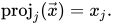
- A set-theoretic operation typified by the
th projection map, written
that takes an element
of the Cartesian product
to the value
- A function that sends an element
to its equivalence class under a specified equivalence relation
or, equivalently, a surjection from a set to another set. The function from elements to equivalence classes is a surjection, and every surjection corresponds to an equivalence relation under which two elements are equivalent when they have the same image. The result of the mapping is written as
when
is understood, or written as
when it is necessary to make
Sources and credits
This article is adapted from the Wikipedia article “Projection (set theory)”, written by its contributors and licensed under CC BY-SA 4.0. Fathomly has changed the layout, removed citation markers, navigation and maintenance notices, and adjusted punctuation. This adapted version is shared under the same license. For references, see the original article.
Fathomly is not affiliated with or endorsed by the Wikimedia Foundation. Spotted a problem? Tell us.
