Projected area
Two-dimensional area measurement of a three-dimensional object projected onto a plane

Projected area is the area measurement of a three-dimensional object by projecting its silhouette on to an arbitrary plane. This is often used in mechanical engineering and architectural engineering related fields, especially for hardness testing, axial stress, wind pressures, and terminal velocity.
The geometrical definition of a projected area is the rectilinear parallel projection of a surface of any shape onto a plane:
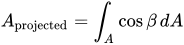

| Shape | Area | Projected area |
|---|---|---|
| Flat rectangle |  |  |
| Circular disc |  | 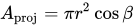 |
| Sphere |  | 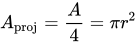 |
Sources and credits
This article is adapted from the Wikipedia article “Projected area”, written by its contributors and licensed under CC BY-SA 4.0. Fathomly has changed the layout, removed citation markers, navigation and maintenance notices, and adjusted punctuation. This adapted version is shared under the same license. For references, see the original article.
Images, from Wikimedia Commons:
- Projected area-hardness test.svg by Wizard191, CC BY-SA 3.0
Fathomly is not affiliated with or endorsed by the Wikimedia Foundation. Spotted a problem? Tell us.

