Reference articles on history, science, culture and more
Encyclopedia

Profinite integer

Number-theoretic concept

In mathematics, a profinite integer is an element of the ring (sometimes pronounced as zee-hat or zed-hat)

{\widehat {\mathbb {Z} }}=\varprojlim \mathbb {Z} /n\mathbb {Z} ,

where the inverse limit of the quotient rings \mathbb {Z} /n\mathbb {Z} runs through all natural numbers n, partially ordered by divisibility. By definition, this ring is the profinite completion of the integers \mathbb {Z}. By the Chinese remainder theorem, {\widehat {\mathbb {Z} }} can also be understood as the direct product of rings

{\widehat {\mathbb {Z} }}=\prod _{p}\mathbb {Z} _{p},

where the index p runs over all prime numbers, and \mathbb {Z} _{p} is the ring of p-adic integers. This group is important because of its relation to Galois theory, étale homotopy theory, and the ring of adeles. In addition, it provides a basic tractable example of a profinite group.

01Construction

The profinite integers {\widehat {\mathbb {Z} }} can be constructed as the set of sequences \upsilon of residues represented as\upsilon =(\upsilon _{1}{\bmod {1}},~\upsilon _{2}{\bmod {2}},~\upsilon _{3}{\bmod {3}},~\ldots )such that m\ |\ n\implies \upsilon _{m}\equiv \upsilon _{n}\!\!\!\!\!{\pmod {m}}. Pointwise addition and multiplication make it a commutative ring.

The ring of integers embeds into the ring of profinite integers by the canonical injection\eta :\mathbb {Z} \hookrightarrow {\widehat {\mathbb {Z} }},where n\mapsto (n{\bmod {1}},n{\bmod {2}},\dots ). It is canonical since it satisfies the universal property of profinite groups that, given any profinite group H and any group homomorphism f:\mathbb {Z} \rightarrow H, there exists a unique continuous group homomorphism g:{\widehat {\mathbb {Z} }}\rightarrow H with f=g\eta.

Using the factorial number system

Every integer n\geq 0 has a unique representation in the factorial number system asn=\sum _{i=1}^{\infty }c_{i}i!\quad {\text{with }}c_{i}\in \mathbb {Z} ,where 0\leq c_{i}\leq i for every i, and only finitely many of c_{1},c_{2},c_{3},\ldots are nonzero. This can be written as (\cdots c_{3}c_{2}c_{1})_{!}.

In the same way, a profinite integer can be uniquely represented in the factorial number system as an infinite string (\cdots c_{3}c_{2}c_{1})_{!}, where each c_{i} is an integer satisfying 0\leq c_{i}\leq i. The digits c_{1},c_{2},c_{3},\ldots ,c_{k-1} determine the value of the profinite integer modulo k!. More specifically, there is a ring homomorphism {\widehat {\mathbb {Z} }}\to \mathbb {Z} /k!\,\mathbb {Z} sending(\cdots c_{3}c_{2}c_{1})_{!}\mapsto \sum _{i=1}^{k-1}c_{i}i!{\bmod {k}}!The difference of a profinite integer from an integer is that the "finitely many nonzero digits" condition is dropped, allowing for its factorial number representation to have infinitely many nonzero digits.

Using the Chinese remainder theorem

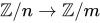
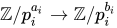
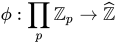
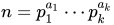
Another way to understand the construction of the profinite integers is by using the Chinese remainder theorem. Recall that for an integer n with prime factorizationn=p_{1}^{a_{1}}\cdots p_{k}^{a_{k}}of non-repeating primes, there is a ring isomorphism\mathbb {Z} /n\cong \mathbb {Z} /p_{1}^{a_{1}}\times \cdots \times \mathbb {Z} /p_{k}^{a_{k}}from the theorem. Moreover, any surjection\mathbb {Z} /n\to \mathbb {Z} /mwill just be a map on the underlying decompositions where there are induced surjections\mathbb {Z} /p_{i}^{a_{i}}\to \mathbb {Z} /p_{i}^{b_{i}}since we must have a_{i}\geq b_{i}. Under the inverse limit definition of the profinite integers, we have the isomorphism{\widehat {\mathbb {Z} }}\cong \prod _{p}\mathbb {Z} _{p}with the direct product of p-adic integers. Explicitly, the isomorphism is \phi :\prod _{p}\mathbb {Z} _{p}\to {\widehat {\mathbb {Z} }} by\phi ((n_{2},n_{3},n_{5},\cdots ))(k)=\prod _{q}n_{q}{\bmod {k}},where q ranges over all prime-power factors p_{i}^{d_{i}} of k; that is, k=\prod _{i=1}^{l}p_{i}^{d_{i}} for some different prime numbers p_{1},...,p_{l}.
02Relations

Topological properties

The set of profinite integers has an induced topology in which it is a compact Hausdorff space (in fact, a Stone space) arising from the fact that it can be seen as a closed subset of the infinite direct product{\widehat {\mathbb {Z} }}\subset \prod _{n=1}^{\infty }\mathbb {Z} /n\mathbb {Z} ,which is compact with its product topology by Tychonoff's theorem. The topology on each finite group \mathbb {Z} /n\mathbb {Z} is given as the discrete topology.

The topology on {\widehat {\mathbb {Z} }} can be defined by the metricd(x,y)={\frac {1}{\min\{k\in \mathbb {Z} _{>0}:x\not \equiv y{\bmod {(k+1)!}}\}}}.Since addition of profinite integers is continuous, {\widehat {\mathbb {Z} }} is a compact Hausdorff abelian group, and thus its Pontryagin dual must be a discrete abelian group. In fact, the Pontryagin dual of {\widehat {\mathbb {Z} }} is the abelian group \mathbb {Q} /\mathbb {Z} equipped with the discrete topology (note that it is not the subset topology inherited from \mathbb {R} /\mathbb {Z}, which is not discrete). The Pontryagin dual is explicitly constructed by the function\mathbb {Q} /\mathbb {Z} \times {\widehat {\mathbb {Z} }}\to U(1),\,(q,a)\mapsto \chi (qa),where \chi is the character of the adele (introduced below) \mathbf {A} _{\mathbb {Q} ,f} induced by \mathbb {Q} /\mathbb {Z} \to U(1),\,\alpha \mapsto e^{2\pi i\alpha }.

Relation with adeles

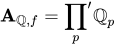
The tensor product {\widehat {\mathbb {Z} }}\otimes _{\mathbb {Z} }\mathbb {Q} is the ring of finite adeles\mathbf {A} _{\mathbb {Q} ,f}={\prod _{p}}'\mathbb {Q} _{p}of \mathbb {Q}, where the symbol ' indicates a restricted product. That is, an element is a sequence that is integral except at a finite number of places. There is an isomorphism\mathbf {A} _{\mathbb {Q} }\cong \mathbb {R} \times ({\widehat {\mathbb {Z} }}\otimes _{\mathbb {Z} }\mathbb {Q} ).

Applications in Galois theory and étale homotopy theory

For the algebraic closure {\overline {\mathbf {F} }}_{q} of a finite field \mathbf {F} _{q} of order q, the Galois group can be computed explicitly. From the fact {\text{Gal}}(\mathbf {F} _{q^{n}}/\mathbf {F} _{q})\cong \mathbb {Z} /n\mathbb {Z} where the automorphisms are given by the Frobenius endomorphism, the Galois group of the algebraic closure of \mathbf {F} _{q} is given by the inverse limit of the groups \mathbb {Z} /n\mathbb {Z}, so its Galois group is isomorphic to the group of profinite integers\operatorname {Gal} ({\overline {\mathbf {F} }}_{q}/\mathbf {F} _{q})\cong {\widehat {\mathbb {Z} }},which gives a computation of the absolute Galois group of a finite field.

Relation with étale fundamental groups of algebraic tori

This construction can be reinterpreted in many ways. One of them is from étale homotopy type, which defines the étale fundamental group \pi _{1}^{et}(X) as the profinite completion of automorphisms\pi _{1}^{et}(X)=\lim _{i\in I}{\text{Aut}}(X_{i}/X),where X_{i}\to X is an étale cover. Then, the profinite integers are isomorphic to the group\pi _{1}^{et}({\text{Spec}}(\mathbf {F} _{q}))\cong {\widehat {\mathbb {Z} }}from the earlier computation of the profinite Galois group. In addition, there is an embedding of the profinite integers inside the étale fundamental group of the algebraic torus{\widehat {\mathbb {Z} }}\hookrightarrow \pi _{1}^{et}(\mathbb {G} _{m}),since the covering maps come from the polynomial maps(\cdot )^{n}:\mathbb {G} _{m}\to \mathbb {G} _{m}from the map of commutative ringsf:\mathbb {Z} [x,x^{-1}]\to \mathbb {Z} [x,x^{-1}]sending x\mapsto x^{n} since \mathbb {G} _{m}={\text{Spec}}(\mathbb {Z} [x,x^{-1}]). If the algebraic torus is considered over a field k, then the étale fundamental group \pi _{1}^{et}(\mathbb {G} _{m}/{\text{Spec(k)}}) contains an action of {\text{Gal}}({\overline {k}}/k) as well from the fundamental exact sequence in étale homotopy theory.

Class field theory and the profinite integers

Class field theory is a branch of algebraic number theory studying the abelian field extensions of a field. Given the global field \mathbb {Q}, the abelianization of its absolute Galois group{\text{Gal}}({\overline {\mathbb {Q} }}/\mathbb {Q} )^{ab}is intimately related to the associated ring of adeles \mathbb {A} _{\mathbb {Q} } and the group of profinite integers. In particular, there is a map, called the Artin map\Psi _{\mathbb {Q} }:\mathbb {A} _{\mathbb {Q} }^{\times }/\mathbb {Q} ^{\times }\to {\text{Gal}}({\overline {\mathbb {Q} }}/\mathbb {Q} )^{ab},which is an isomorphism. This quotient can be determined explicitly as{\begin{aligned}\mathbb {A} _{\mathbb {Q} }^{\times }/\mathbb {Q} ^{\times }&\cong (\mathbb {R} \times {\widehat {\mathbb {Z} }})/\mathbb {Z} \\&={\underset {\leftarrow }{\lim }}\mathbb {(} {\mathbb {R} }/m\mathbb {Z} )\\&={\underset {x\mapsto x^{m}}{\lim }}S^{1}\\&={\widehat {\mathbb {Z} }},\end{aligned}}giving the desired relation. There is an analogous statement for local class field theory since every finite abelian extension of K/\mathbb {Q} _{p} is induced from a finite field extension \mathbb {F} _{p^{n}}/\mathbb {F} _{p}.

Watch videos about Profinite integerExplainers and documentaries on YouTube (opens in a new tab)

Sources and credits

This article is adapted from the Wikipedia article Profinite integer, written by its contributors and licensed under CC BY-SA 4.0. Fathomly has changed the layout, removed citation markers, navigation and maintenance notices, and adjusted punctuation. This adapted version is shared under the same license. For references, see the original article.

Fathomly is not affiliated with or endorsed by the Wikimedia Foundation. Spotted a problem? Tell us.