Probalign
Probalign is a sequence alignment tool that calculates a maximum expected accuracy alignment using partition function posterior probabilities. Base pair probabilities are estimated using an estimate similar to the Boltzmann distribution. The partition function is calculated using a dynamic programming approach.
01Algorithm
The following describes the algorithm used by probalign to determine the base pair probabilities.
Alignment score
To score an alignment of two sequences two things are needed:
- a similarity function
(e.g. PAM, BLOSUM,...)
- affine gap penalty:
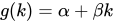
The score 

Now the boltzmann weighted score of an alignment a is:

Where 
The probability of an alignment assuming boltzmann distribution is given by
![Pr[a|x,y]={\frac {e^{\frac {S(a)}{T}}}{Z}}](https://wikimedia.org/api/rest_v1/media/math/render/svg/bc95755b68056106788d9ba71ad9e9bc5be6fafb)
Where 
Dynamic programming
Let 


the partition function of all alignments of the two prefixes that end in a match.
the partition function of all alignments of the two prefixes that end in an insertion
.
the partition function of all alignments of the two prefixes that end in a deletion
.
Then we have:

Initialization
The matrixes are initialized as follows:
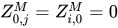


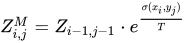
Recursion
The partition function for the alignments of two sequences 


analogously

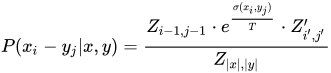
Base pair probability
Finally the probability that positions 


Sources and credits
This article is adapted from the Wikipedia article “Probalign”, written by its contributors and licensed under CC BY-SA 4.0. Fathomly has changed the layout, removed citation markers, navigation and maintenance notices, and adjusted punctuation. This adapted version is shared under the same license. For references, see the original article.
Fathomly is not affiliated with or endorsed by the Wikimedia Foundation. Spotted a problem? Tell us.
