ProbLog
Probabilistic logic programming language
ProbLog is a probabilistic logic programming language that extends Prolog with probabilities. It minimally extends Prolog by adding the notion of a probabilistic fact, which combines the idea of logical atoms and random variables. Similarly to Prolog, ProbLog can query an atom. While Prolog returns the truth value of the queried atom, ProbLog returns the probability of it being true.
01Semantics
A probabilistic fact is a pair 

![p\in [0,1]](https://wikimedia.org/api/rest_v1/media/math/render/svg/33c3a52aa7b2d00227e85c641cca67e85583c43c)





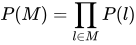



ProbLog supports multiple tasks:
- Probabilistic inference: calculate
- Most probable explanation: calculate the most probable model probability
- Sampling: generate samples of
- Learning from interpretations: learn the probabilities of ProbLog programs from data


Example
ProbLog can for example be used to calculate the probability of getting wet given the probabilities for rain and the probabilities that someone brings an umbrella as follows:
0.4 :: rain(weekday). 0.9 :: rain(weekend). 0.8 :: umbrella_if_rainy(Day). 0.2 :: umbrella_if_dry(Day). umbrella(Day) :- rain(Day), umbrella_if_rainy(Day). umbrella(Day) :- \+rain(Day), umbrella_if_dry(Day). wet(Day) :- rain(Day), \+umbrella(Day). query(\+wet(weekend)).The last rule before the query states that someone gets wet if it rains and no umbrella was brought. When ProbLog is asked to solve the "probabilistic inference" task, the query asks for the probability to stay dry on a weekend day. When solving the "most probable explanation" task, ProbLog will return the most likely reason for staying dry, i.e. because it is not raining or because the person has an umbrella.
02Implementations
The ProbLog language has been implemented as a YAP Prolog library (ProbLog 1). and as a stand-alone Python framework (ProbLog 2) The source code of ProbLog 2 is licensed under Apache License, Version 2.0 and available on GitHub. The ProbLog language has also been implemented as part of the cplint probabilistic logic programming package for SWI-Prolog, YAP and XSB.
03ProbLog variants
ProbLog has been extended or used as inspiration for several different variants, including:
- DeepProbLog extends ProbLog by allowing the probability to be parametrized by a neural network.
- DTProblog extends ProbLog with decision theory. The utility of a strategy is defined as the expected reward for its execution in the presence of probabilistic effects.
- DC-ProbLog extends ProbLog with distributional facts, meaning that instead of probabilities, a logic atom has a corresponding continuous probability distribution instead.
- aProbLog generalizes ProbLog by allowing any commutative semiring instead of just probabilities.
- ProbFOIL: given a set of ProbLog facts as a probabilistic relational database, ProbFOIL finds a set of probabilistic rules to predict the facts of one relation based on all other relations.
Sources and credits
This article is adapted from the Wikipedia article “ProbLog”, written by its contributors and licensed under CC BY-SA 4.0. Fathomly has changed the layout, removed citation markers, navigation and maintenance notices, and adjusted punctuation. This adapted version is shared under the same license. For references, see the original article.
Fathomly is not affiliated with or endorsed by the Wikimedia Foundation. Spotted a problem? Tell us.