Prismatoid
Polyhedron with all vertices in two parallel planes

In geometry, a prismatoid is a convex polyhedron whose vertices all lie in two parallel planes. Its lateral faces can be trapezoids or triangles. If both planes have the same number of vertices, and the lateral faces are either parallelograms or trapezoids, it is called a prismoid.
01Volume
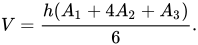
If the areas of the two parallel faces are A1 and A3, the cross-sectional area of the intersection of the prismatoid with a plane midway between the two parallel faces is A2, and the height (the distance between the two parallel faces) is h, then the volume of the prismatoid is given by

02Prismatoid families
Families of prismatoids include:
- Pyramids, in which one plane contains only a single point;
- Wedges, in which one plane contains only two points;
- Prisms, whose polygons in each plane are congruent and joined by rectangles or parallelograms;
- Antiprisms, whose polygons in each plane are congruent and joined by an alternating strip of triangles;
- Star antiprisms;
- Cupolae, in which the polygon in one plane contains twice as many points as the other and is joined to it by alternating triangles and rectangles;
- Frusta obtained by truncation of a pyramid or a cone;
- Quadrilateral-faced hexahedral prismatoids:
- Parallelepipeds, six parallelogram faces
- Rhombohedrons, six rhombus faces
- Trigonal trapezohedra, six congruent rhombus faces
- Cuboids, six rectangular faces
- Quadrilateral frusta, an apex-truncated square pyramid
- Cube, six square faces
03Higher dimensions
In general, a polytope is prismatoidal if its vertices exist in two hyperplanes. For example, in four dimensions, two polyhedra can be placed in two parallel 3-spaces, and connected with polyhedral sides.
Sources and credits
This article is adapted from the Wikipedia article “Prismatoid”, written by its contributors and licensed under CC BY-SA 4.0. Fathomly has changed the layout, removed citation markers, navigation and maintenance notices, and adjusted punctuation. This adapted version is shared under the same license. For references, see the original article.
Images, from Wikimedia Commons:
- Prismatoid (parameters h,A₁,A₂,A₃).svg by Steven Baltakatei Sandoval, CC BY-SA 4.0
- 4D Tetrahedral Cupola-perspective-cuboctahedron-first.png by Tetracube, CC BY 3.0
Fathomly is not affiliated with or endorsed by the Wikimedia Foundation. Spotted a problem? Tell us.