Reference articles on history, science, culture and more
Encyclopedia

Prime avoidance lemma

Result concerning ideals of commutative rings

In algebra, the prime avoidance lemma says that if an ideal I in a commutative ring R is contained in a union of finitely many prime ideals Pi's, then it is contained in Pi for some i.

There are many variations of the lemma (cf. Hochster); for example, if the ring R contains an infinite field or a finite field of sufficiently large cardinality, then the statement follows from a fact in linear algebra that a vector space over an infinite field or a finite field of large cardinality is not a finite union of its proper vector subspaces.

01Statement and proof

The following statement and argument are perhaps the most standard.

Theorem (Prime Avoidance Lemma): Let E be a subset of commutative ring R that is an additive subgroup of R and is multiplicatively closed. (In particular, E could be a subring or ideal of R.) Let I_{1},I_{2},\dots ,I_{n},n\geq 1 be ideals such that I_{i} are prime ideals for i\geq 3. If E is not contained in any of the I_{i}, then E is not contained in the union {\textstyle \bigcup I_{i}.

Proof by induction on n: The idea is to find an element of R that is in E and not in any of the I_{i}. The base case n=1 is trivial. Next suppose n\geq 2. For each i, choose

z_{i}\in E\setminus \bigcup _{j\neq i}I_{j},

where each of the sets on the right is nonempty by the inductive hypothesis. We can assume z_{i}\in I_{i} for all i; otherwise, there is some z_{k} among them that avoids all of the I_{i}, and we are done. Put

z=z_{1}\cdots z_{n-1}+z_{n}.

Because E is closed under addition and multiplication, z is in E by construction. We claim that z is not in any of the I_{i}. Indeed, if z\in I_{i} for some i\leq n-1, then z_{n}\in I_{i}, a contradiction. Next suppose z\in I_{n}. Then z_{1}\cdots z_{n-1}\in I_{n}. If n=2, this is already a contradiction. If n>2, then, since I_{n} is a prime ideal, z_{i}\in I_{n} for some i\leq n-1, again a contradiction. \square

02E. Davis' prime avoidance

There is the following variant of prime avoidance due to E. Davis.

Theorem, Let A be a ring, {\mathfrak {p}}_{1},\dots ,{\mathfrak {p}}_{r} prime ideals, x an element of A and J an ideal. For the ideal I=xA+J, if I\not \subset {\mathfrak {p}}_{i} for each i, then there exists some y in J such that x+y\not \in {\mathfrak {p}}_{i} for each i.

Proof: We argue by induction on r. Without loss of generality, we can assume there is no inclusion relation between the {\mathfrak {p}}_{i}'s; since otherwise we can use the inductive hypothesis.

Also, if x\not \in {\mathfrak {p}}_{i} for each i, then we are done; thus, without loss of generality, we can assume x\in {\mathfrak {p}}_{r}. By inductive hypothesis, we find a y in J such that x+y\in I-\cup _{1}^{r-1}{\mathfrak {p}}_{i}. If x+y is not in {\mathfrak {p}}_{r}, we are done. Otherwise, note that J\not \subset {\mathfrak {p}}_{r} (since x\in {\mathfrak {p}}_{r}) and since {\mathfrak {p}}_{r} is a prime ideal, we have:

{\mathfrak {p}}_{r}\not \supset J\,{\mathfrak {p}}_{1}\cdots {\mathfrak {p}}_{r-1}.

Hence, we can choose y' in J\,{\mathfrak {p}}_{1}\cdots {\mathfrak {p}}_{r-1} that is not in {\mathfrak {p}}_{r}. Then, since x+y\in {\mathfrak {p}}_{r}, the element x+y+y' has the required property. \square

Application

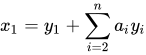
Let A be a Noetherian ring, I an ideal generated by n elements and M a finite A-module such that IM\neq M. Also, let d=\operatorname {depth} _{A}(I,M) = the maximal length of M-regular sequences in I = the length of every maximal M-regular sequence in I. Then d\leq n; this estimate can be shown using the above prime avoidance as follows. We argue by induction on n. Let \{{\mathfrak {p}}_{1},\dots ,{\mathfrak {p}}_{r}\} be the set of associated primes of M. If d>0, then I\not \subset {\mathfrak {p}}_{i} for each i. If I=(y_{1},\dots ,y_{n}), then, by prime avoidance, we can choose

x_{1}=y_{1}+\sum _{i=2}^{n}a_{i}y_{i}

for some a_{i} in A such that x_{1}\not \in \cup _{1}^{r}{\mathfrak {p}}_{i} = the set of zero divisors on M. Now, I/(x_{1}) is an ideal of A/(x_{1}) generated by n-1 elements and so, by inductive hypothesis, \operatorname {depth} _{A/(x_{1})}(I/(x_{1}),M/x_{1}M)\leq n-1. The claim now follows.

Watch videos about Prime avoidance lemmaExplainers and documentaries on YouTube (opens in a new tab)

Sources and credits

This article is adapted from the Wikipedia article Prime avoidance lemma, written by its contributors and licensed under CC BY-SA 4.0. Fathomly has changed the layout, removed citation markers, navigation and maintenance notices, and adjusted punctuation. This adapted version is shared under the same license. For references, see the original article.

Fathomly is not affiliated with or endorsed by the Wikimedia Foundation. Spotted a problem? Tell us.