Baronage of Scotland
Heritable title of honour in Scotland

In Scotland, a "baron" or "baroness" holds a barony within the Baronage of Scotland, recognised as titled nobility. The holder of a barony having the status of a minor baron. Scottish baronies are heritable titles of honour, originally created by Crown charter from the medieval period onward. They are distinct from the Peerage of Scotland; a Scottish baron is noble but not a peer, and the Scottish equivalent of an English baron is the higher title of Lord of Parliament. Scottish baronies differ from British peerage and baronetage titles in that they may be succeeded by alienation, not solely by inheritance. Unlike these titles, they are not governed by strict succession rules and have remainders to "heirs and assignees", as stated in Crown charters. These titles are also excluded from the Honours (Prevention of Abuses) Act 1925, since they are not newly created honours but existing dignities recognised in law.
Historically, a barony combined a defined estate with land with local jurisdictional power; barons administered justice through baron's courts, and sat in the Parliament of Scotland. Their powers were curtailed in the 18th century, and Scottish baronies survived into modern times principally as titles of honour attached to land. Although being historically referred to as feudal barons, the term feudal is now incorrect. The Abolition of Feudal Tenure etc. (Scotland) Act 2000, which came into force in 2004, severed baronies from the land to which they had been attached. They became non-territorial dignities, or personal honours in law, with no associated land rights. The heraldic privileges associated with a barony are regulated by the Court of the Lord Lyon, although the Lord Lyon King of Arms has no jurisdiction over the assignation of the title itself.
01History
Scottish baronies originated as grants of land by the Crown in liberam baroniam, conferring on the holder both an estate and the jurisdiction to administer justice within it. They were heritable and, in time, prescriptive: a barony attached to the land rather than to the person, and could be alienated together with the caput, the principal seat of the barony, rather than passing solely by inheritance. Most Scottish baronies were created before 1745, although a small number were erected as late as 1824.
A barony required a Crown charter erecting specified lands into a barony, recorded in the Register of the Great Seal of Scotland. Where the original charter was later lost, an official extract from the Register carried the same legal weight. The General Register of Sasines, established by statute in 1617, provided a public record of land transfers and conferred prescriptive rights over the caput. The Lyon Register, established in 1672, performed the equivalent function for armorial bearings: from that date no arms could be lawfully borne in Scotland unless recorded in the Lyon Register. From 1874, the requirement that each new baron be confirmed by the Crown through a charter of confirmation was abolished, and transfers were thereafter recorded by ordinary disposition in the Register of Sasines.
Barons sat in the Parliament of Scotland as part of the Second Estate. An Act of 1428 by James I sought to allow the smaller barons to be represented by elected shire commissioners, but the measure was inoperative; shire representation did not become regular until the 1428 act was revived in 1587. Greater barons frequently acquired peerage titles over time, becoming lords of parliament, earls, or dukes; lesser barons retained local influence through their baron's courts. The jurisdictions exercised by baron's courts were substantially curtailed by the Heritable Jurisdictions (Scotland) Act 1746, passed in the aftermath of the Jacobite rising of 1745, which confined them to minor civil and criminal matters.
Following the Acts of Union of 1707, legislative authority over Scottish private law passed to the Parliament of Great Britain at Westminster and, from 1999, to the devolved Scottish Parliament. The Scottish Parliament's first major reform of land law was the Abolition of Feudal Tenure etc. (Scotland) Act 2000, which came fully into force on 28 November 2004. The Act abolished the feudal system of land tenure in Scotland and severed baronies from the land to which they had been attached. Existing baronies were preserved as dignities, incorporeal hereditaments, comparable in status to hereditary peerages, baronetcies, and coats of arms, but no longer conferred any right to land. The Act marked the end of the ability to acquire a barony by purchasing land containing the caput.
Since 2000, baronies are thus "floating" dignities, capable of being assigned by their holder or bequeathed by will. Where a baron dies intestate, the dignity is inherited under the pre-1964 rules of succession, which the Succession (Scotland) Act 1964 preserved for titles and dignities. The Court of the Lord Lyon retains jurisdiction over the heraldic aspects of baronies; a holder may petition for a grant of arms and for the appropriate baronial additaments. The Court has no jurisdiction over the legal assignation of baronies, which is a matter of civil law.
Lordships
The medieval baronage existed alongside, and overlapped with, a category of greater territorial dignities known as the "provincial lordships". These were extensive territories such as the lordships of Annandale, Badenoch, Galloway, Lorne, and the Lordship of the Isles, which corresponded to whole provinces and resembled earldoms in scale rather than the ordinary barony. Over the 14th and 15th centuries these provincial lordships largely ceased to exist as a distinct category: most were absorbed into earldoms, came into the hands of the Crown, or became lordships of parliament, that is, peerages. By the middle of the 15th century the higher dignities of duke, earl, and lord of parliament had developed into a personal, honorific peerage, distinct from the baronage out of which the greater barons had been drawn.
Within the Baronage of Scotland, the holder of a lordship may be styled either "Lord of X" or "Baron of X", both are correct, "Lord of X" being the higher style, for example the Lord of Arbroath. By contrast, the holder of an ordinary barony, one not erected into a lordship, is styled only "Baron of X". Nevertheless, the institutional writer Lord Stair described such lordships within the baronage as "but more noble titles of a barony" in 1681.
02Acquisition and transfer since 2004
The Abolition of Feudal Tenure etc. (Scotland) Act 2000 separated Scottish baronies from the land with which they had previously been associated. As a result, baronial titles became freely transferable and may be bought, sold, gifted, or bequeathed independently of any landholding, with the transferee becoming the new holder of the dignity. Baronies may be acquired by any individual regardless of nationality or place of residence, and many transfers since 2004 have involved purchasers from outside Scotland and the United Kingdom. The explanatory notes to the Act observed that a market in Scottish baronies had developed in recent years and cited a Scottish Law Commission estimate that, based on 1997 market evidence, a barony of no particular distinction was worth approximately £60,000. In 2002, the Barony of MacDonald of the Isle of Skye was reported to have been offered for sale for more than £1 million. Transfer is effected by written assignation. Baronies are not registrable in the Land Register, and deeds relating to them are no longer recordable in the Register of Sasines.
A non-statutory "Scottish Barony Register" was established by members of the Scottish legal profession in 2004 to record transfers. The Scottish Barony Register enjoys a unique legal standing, having reached an understanding with the Lord Lyon King of Arms whereby certification issued by the Custodian of the Register is accepted as sufficient evidence that a petitioner holds the baronial title or dignity in question for the purposes of proceedings before the Lyon Court.
03Styles and forms of address
Holders of a Scottish barony may incorporate the title into their name in the form "John Doe, Baron of X" or "Jane Doe, Baroness of X". Where the holder is also in possession of the caput, and has permission of the Lord Lyon, the territorial designation may be combined with the title, as in "John Doe of X, Baron of X"; some families prefer to use the territorial designation alone ("Doe of X"). The name recorded by the Lord Lyon King of Arms in a grant or matriculation of arms becomes the holder's official name for legal purposes.
The standard third-person forms are "The Baron of X" and "The Baroness of X". The form "Baron X" is incorrect, as it implies a peerage title. Where the husband holds the barony, his wife is granted a courtesy title and may be styled "Baroness of X" or "Lady X"; the husband of a substantive baroness receives no courtesy title. The eldest son of a baron or baroness may use the territorial designation with the suffix "yr" (younger) if approved by the Lord Lyon. In formal correspondence, the honorific prefix The Much Honoured (abbreviated as The Much Hon.) can be used.
04Heraldry
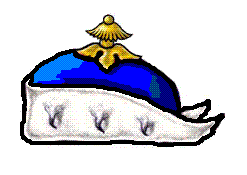
The heraldic privileges of Scottish barons are regulated by the Lord Lyon King of Arms, who exercises authority over the granting and matriculation of arms in Scotland. A holder may petition the Lyon Court for a grant of arms and is entitled to bear the helm and additaments appropriate to the dignity. Barons may wear two eagle feathers when dressed in Highland attire; for those belonging to a clan, the practice is subject to consultation with the clan chief. Between the 1930s and 2004, the Lord Lyon also granted a chapeau or cap of maintenance to barons as part of their armorial achievement: gules doubled ermine for barons in possession of the caput, and an azure version for heirs of ancient baronial families no longer holding the estates. The Baron of the Bachuil is uniquely permitted to use a chapeau lined with vair (squirrel fur). The chapeau was an addition introduced under Thomas Innes of Learney as Lord Lyon and is no longer granted; many earlier baronial arms do not include it.
05List of baronies
Below is an incomplete list of baronies created in the Scottish baronage. Titles in italics are subsidiary baronial titles held by the same baron. Titles linked and with The before the name is the holder's primary title.
a: The creation date is the earliest known date for the barony and subject to revision.
b: C before the date is circa around this date of before. C after the date = century.
Higher titles
- List of Earldoms in the Baronage of Scotland, the third degree of baronage nobility, nobler than Baron (first) and Lord (second)
- List of Marquisates and Dukedoms in the Baronage of Scotland, the noblest forms in the hierarchy
- List of Lordships of Regality, erected in liberam regalitatem
Sources and credits
This article is adapted from the Wikipedia article “Baronage of Scotland”, written by its contributors and licensed under CC BY-SA 4.0. Fathomly has changed the layout, removed citation markers, navigation and maintenance notices, and adjusted punctuation. This adapted version is shared under the same license. For references, see the original article.
Images, from Wikimedia Commons:
- Ayton Castle - geograph.org.uk - 813849.jpg by James Yardley, CC BY-SA 2.0
- Azure Chapeau.PNG by Generic_Character (talk) (Uploads), CC BY-SA 3.0
Fathomly is not affiliated with or endorsed by the Wikimedia Foundation. Spotted a problem? Tell us.

