Positive and negative parts
Decomposition of real-valued functions

In mathematics, the positive part of a real or extended real-valued function is defined by the formula

Intuitively, the graph of 

Similarly, the negative part of f is defined as

Note that both f+ and f− are non-negative functions. A peculiarity of terminology is that the 'negative part' is not negative (like the imaginary part of a complex number is not imaginary).
The function f can be expressed in terms of f+ and f− as
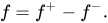
Also note that
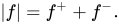
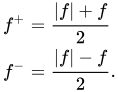
Using these two equations one may express the positive and negative parts as
Another representation, using the Iverson bracket is
![{\begin{aligned}f^{+}&=[f>0]f\\f^{-}&=-[f<0]f.\end{aligned}}](https://wikimedia.org/api/rest_v1/media/math/render/svg/24f9c57f5158b56786f9fa6c1c629c8439feda39)
One may define the positive and negative part of any function with values in a linearly ordered group.
The unit ramp function is the positive part of the identity function.
01Measure-theoretic properties
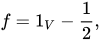
Given a measurable space (X, Σ), an extended real-valued function f is measurable if and only if its positive and negative parts are. Therefore, if such a function f is measurable, so is its absolute value |f|, being the sum of two measurable functions. The converse, though, does not necessarily hold: for example, taking f as
The positive part and negative part of a function are used to define the Lebesgue integral for a real-valued function. Analogously to this decomposition of a function, one may decompose a signed measure into positive and negative parts , see the Hahn decomposition theorem.
Sources and credits
This article is adapted from the Wikipedia article “Positive and negative parts”, written by its contributors and licensed under CC BY-SA 4.0. Fathomly has changed the layout, removed citation markers, navigation and maintenance notices, and adjusted punctuation. This adapted version is shared under the same license. For references, see the original article.
Images, from Wikimedia Commons:
- Positive and Negative Parts of f(x) = x^2 - 4.png by Maxime182752, CC BY-SA 4.0
Fathomly is not affiliated with or endorsed by the Wikimedia Foundation. Spotted a problem? Tell us.


