Position operator
Operator in quantum mechanics
In quantum mechanics, the position operator is the operator that corresponds to the position observable of a particle.
When the position operator is considered with a wide enough domain (e.g. the space of tempered distributions), its eigenvalues are the possible position vectors of the particle.
In one dimension, if by the symbol 

Therefore, denoting the position operator by the symbol 
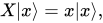
One possible realization of the unitary state with position 
In quantum mechanics, the ordered (continuous) family of all Dirac distributions, i.e. the family

It is fundamental to observe that there exists only one linear continuous operator 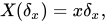



01Introduction
Consider representing the quantum state of a particle at a certain instant of time by a square integrable wave function 
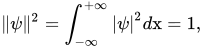
![[a,b]](https://wikimedia.org/api/rest_v1/media/math/render/svg/9c4b788fc5c637e26ee98b45f89a5c08c85f7935)
![\pi _{X}(\psi )([a,b])=\int _{a}^{b}|\psi |^{2}d\mathrm {x} .](https://wikimedia.org/api/rest_v1/media/math/render/svg/99c0bc2d0b3ea0beaf5ebe9b39ca952be0c4f44c)
Hence the expected value of a measurement of the position 

Strictly speaking, the observable position 



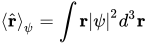
Three dimensions
The generalisation to three dimensions is straightforward.
The space-time wavefunction is now 


02Basic properties
In the above definition, which regards the case of a particle confined upon a line, the careful reader may remark that there does not exist any clear specification of the domain and the co-domain for the position operator. In literature, more or less explicitly, we find essentially three main directions to address this issue.
- The position operator is defined on the subspace
of
formed by those equivalence classes
reveals not continuous (unbounded with respect to the topology induced by the canonical scalar product of
- The position operator is defined on the Schwartz space
(i.e. the nuclear space of all smooth complex functions defined upon the real-line whose derivatives are rapidly decreasing). In this case the position operator
reveals continuous (with respect to the canonical topology of
- The position operator is defined on the dual space
of
reveals continuous (with respect to the canonical topology of
is self-adjoint, that is


The last case is, in practice, the most widely adopted choice in Quantum Mechanics literature, although never explicitly underlined. It addresses the possible absence of eigenvectors by extending the Hilbert space to a rigged Hilbert space:

03Eigenstates
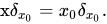
The eigenfunctions of the position operator (on the space of tempered distributions), represented in position space, are Dirac delta functions.
Informal proof. To show that possible eigenvectors of the position operator should necessarily be Dirac delta distributions, suppose that 






04Momentum space
Usually, in quantum mechanics, by representation in the momentum space we intend the representation of states and observables with respect to the canonical unitary momentum basis
![\eta =\left(\left[(2\pi \hbar )^{-{\frac {1}{2}}}e^{(\iota /\hbar )(\mathrm {x} |p)}\right]\right)_{p\in \mathbb {R} }.](https://wikimedia.org/api/rest_v1/media/math/render/svg/f13ac8685937ffef1a1c51897b09b8943c2aa17c)
In momentum space, the position operator in one dimension is represented by the following differential operator

where:
- the representation of the position operator in the momentum basis is naturally defined by
, for every wave function (tempered distribution)
represents the coordinate function on the momentum line and the wave-vector function
is defined by
.
05Formalism in L2(R, C)
Consider the case of a spinless particle moving in one spatial dimension. The state space for such a particle contains 
The position operator is defined as the self-adjoint operator






Immediately from the definition we can deduce that the spectrum consists of the entire real line and that 
The three-dimensional case is defined analogously. We shall keep the one-dimensional assumption in the following discussion.
06Measurement theory in L2(R, C)
As with any quantum mechanical observable, in order to discuss position measurement, we need to calculate the spectral resolution of the position operator



Let 


Therefore, if the system is prepared in a state 

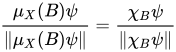
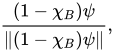
After any measurement aiming to detect the particle within the subset B, the wave function collapses to either

Sources and credits
This article is adapted from the Wikipedia article “Position operator”, written by its contributors and licensed under CC BY-SA 4.0. Fathomly has changed the layout, removed citation markers, navigation and maintenance notices, and adjusted punctuation. This adapted version is shared under the same license. For references, see the original article.
Fathomly is not affiliated with or endorsed by the Wikimedia Foundation. Spotted a problem? Tell us.