Polyxenus Epiphanes Soter
Indo-Greek king

Polyxenus Epiphanes Soter (Ancient Greek: Πολύξενος Ἐπιφανῆς Σωτήρ, romanized: Polyxenos Epiphanēs Sōtēr, "Polyxenus the Illustrious Saviour") was an Indo-Greek king who ruled briefly in western Punjab or Gandhara.
01Date
Osmund Bopearachchi places Polyxenus c. 100 BC and R. C. Senior c. 85-80 BC.

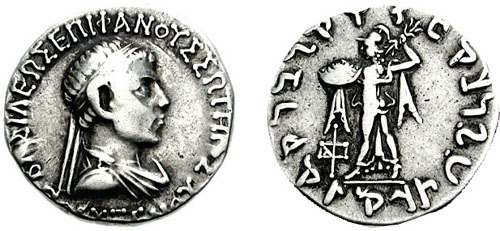
02Coinage
Polyxenus, whose portraits depict a diademed young man, struck silver coins which closely resemble those of Strato I. Both kings used the epithets Soter Epiphanes and the reverse of Athena Alcidemus (fighting Pallas Athene), the emblem of the dynasty of Menander I. Polyxenus also struck bronzes with Athena on the obverse and her aegis on the reverse. He issued no Attic silver.
His bronzes depict the head of Athena with a reverse of her aegis.
Polyxenus' coins are few and feature only three monograms: these he shares with Strato I as well as Heliocles II and Archebius, according to Bopearachchi and RC Senior.
He was therefore likely to have been a brief contestant for power in the central Indo-Greek kingdom after the presumably violent death of Straton I, who was possibly his father.

Sources and credits
This article is adapted from the Wikipedia article “Polyxenus Epiphanes Soter”, written by its contributors and licensed under CC BY-SA 4.0. Fathomly has changed the layout, removed citation markers, navigation and maintenance notices, and adjusted punctuation. This adapted version is shared under the same license. For references, see the original article.
Images, from Wikimedia Commons:
- Polyxenos portrait.jpg by CNG Coins Coin from CNG coins. Used with permission (CNG coin [1])., CC BY-SA 3.0
- Polyxenos round bilingual.jpg by CNG Coins. Uploaded by Beads and Reels, CC BY-SA 3.0
- Polyxenos.jpg by Classical Numismatic Group; [1], CC BY-SA 3.0
- Polyxenos square bilingual.jpg by CNG Coins. Uploaded by Beads and Reels, CC BY-SA 3.0
Fathomly is not affiliated with or endorsed by the Wikimedia Foundation. Spotted a problem? Tell us.