02Primitive part-content factorization
In this section, we show that factoring over Q (the rational numbers) and over Z (the integers) is essentially the same problem.
The content of a polynomial p ∈ Z[X], denoted "cont(p)", is, up to its sign, the greatest common divisor of its coefficients. The primitive part of p is primpart(p) = p/cont(p), which is a primitive polynomial with integer coefficients. This defines a factorization of p into the product of an integer and a primitive polynomial. This factorization is unique up to the sign of the content. It is a usual convention to choose the sign of the content such that the leading coefficient of the primitive part is positive.
For example,

is a factorization into content and primitive part.
Every polynomial q with rational coefficients may be written

where p ∈ Z[X] and c ∈ Z: it suffices to take for c a multiple of all denominators of the coefficients of q (for example their product) and p = cq. The content of q is defined as:
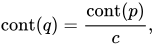
and the primitive part of q is that of p. As for the polynomials with integer coefficients, this defines a factorization into a rational number and a primitive polynomial with integer coefficients. This factorization is also unique up to the choice of a sign.
For example,

is a factorization into content and primitive part.
Gauss proved that the product of two primitive polynomials is also primitive (Gauss's lemma). This implies that a primitive polynomial is irreducible over the rationals if and only if it is irreducible over the integers. This implies also that the factorization over the rationals of a polynomial with rational coefficients is the same as the factorization over the integers of its primitive part. Similarly, the factorization over the integers of a polynomial with integer coefficients is the product of the factorization of its primitive part by the factorization of its content.
In other words, an integer GCD computation reduces the factorization of a polynomial over the rationals to the factorization of a primitive polynomial with integer coefficients, and the factorization over the integers to the factorization of an integer and a primitive polynomial.
Everything that precedes remains true if Z is replaced by a polynomial ring over a field F and Q is replaced by a field of rational functions over F in the same variables, with the only difference that "up to a sign" must be replaced by "up to the multiplication by an invertible constant in F". This reduces the factorization over a purely transcendental field extension of F to the factorization of multivariate polynomials over F.
 , then all possible linear factors are of the form
  , where
  is an integer factor of
  and
and  is an integer factor of
  . All possible combinations of integer factors can be tested for validity, and each valid one can be factored out using
  is a polynomial with integer coefficients, then
  is an integer as soon as
  is a factor of
  the value of
  must be one of the factors of
 values,
  for
for  Each
Each  has a finite number of divisors
  , and, each
  -tuple where the
  entry is a divisor of
  , produces a unique polynomial of degree at most
  , which can be computed by
  and each
  .
. must be of degree two or less, so
  ,
,  and
and  . If one of these values is 0, we have a linear factor. If the values are nonzero, we can list the possible factorizations for each. Now, 2 can only factor as
 as possible factors of
 , so that
  . Now one can test recursively to find factors of p(x) and q(x), in this case using the rational root test. It turns out they are both irreducible, so the irreducible factorization of f(x) is:
 such that any factor
  is an integer larger than
  , and if
  such that the image of
  remains
  whose product matches
  in such a way that their product matches
  , where
  is large enough that
  exceeds
  factors (up to units): the products of all subsets of
  . These factors modulo
 ![\mathbb {Z} [x]](https://wikimedia.org/api/rest_v1/media/math/render/svg/0d4da3ac703cc7721ebba91a53f6752de7157124) , but we can easily test them by division in
, but we can easily test them by division in  cases by skipping complements. If
  entries in {0,1} that encode the subsets of
 ![p(x)\in K[x]](https://wikimedia.org/api/rest_v1/media/math/render/svg/f6a1593b7363ee2924833e9f3f3d40afdc877bf4) , where the field
, where the field  is a finite extension of
  . First, using
 ![L=K[x]/p(x)](https://wikimedia.org/api/rest_v1/media/math/render/svg/23fa5e5f328fcae68b1c92d76133a8adf909f99b) of degree
of degree ![n=[L:\mathbb {Q} ]=\deg p(x)\,[K:\mathbb {Q} ]](https://wikimedia.org/api/rest_v1/media/math/render/svg/604937154e5decc0470da419d180ef3186af2228) ; this is not a field unless
; this is not a field unless 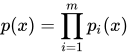
![L=K[x]/p(x)\cong \prod _{i=1}^{m}K[x]/p_{i}(x).](https://wikimedia.org/api/rest_v1/media/math/render/svg/45653709b35f3ab38e1afec096c4bffd66ee66cf)
 , which generates
  over
over ![q(y)\in \mathbb {Q} [y]](https://wikimedia.org/api/rest_v1/media/math/render/svg/9c7d5f08cfaf2e48d542ff98e0f3dcf6a270384f) of
of  over
over ![\mathbb {Q} [y]](https://wikimedia.org/api/rest_v1/media/math/render/svg/f26869300af791a1b9c750b3517a92d7620f1422) :
: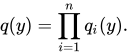
![L\cong \mathbb {Q} [y]/q(y)\cong \prod _{i=1}^{n}\mathbb {Q} [y]/q_{i}(y),](https://wikimedia.org/api/rest_v1/media/math/render/svg/ebc961aa570089c8447621ff38a32524987e5ba4)
 . This must be isomorphic to the previous decomposition of
  and
and ![\mathbb {Q} [y]/q_{i}(y)=K[x]/p_{i}(x)](https://wikimedia.org/api/rest_v1/media/math/render/svg/029f7bc111c1386246295bf3d165346201a4892b) . By finding the minimal polynomial of
. By finding the minimal polynomial of ![\mathbb {Q} [y]/q_{i}(y)](https://wikimedia.org/api/rest_v1/media/math/render/svg/18bced4a06aa896712e75a59798bc43d7f15acb2) , we compute
, we compute  , and thus factor
 , into two identical polynomial roots,
  , using an example from
 , and place it,
  , in the leading term of the solution R polynomial solution row on top, and place the
 ![{\begin{aligned}n&={\text{order of the squared polynomial being factored}}\\m&={\text{order of the extracted square root polynomial}}=n/2\\S&{\text{ is the squared polynomial, indexed in powers of x, and normalized to the highest order term value of 1}}\\R&{\text{ is the square root polynomial, indexed in powers of x, and with the highest order term initialized to 1}}\\T&{\text{ and }}D{\text{ are vectors of length n, with all entries initialized to 0}}\\\\&\sum _{i=1}^{m}{{\Bigg [}{\Big (}\sum _{k=i}^{0}}D_{n-i-k}={\begin{cases}S_{n-i-k},&{\text{if }}k\geq i-1\\D_{n-i-k}-T_{n-i-k},&{\text{if }}k<i-1\end{cases}}{\Big )}{\text{ ;}}\quad R_{m-i}={\frac {D_{n-i}}{2}}{\text{ ;}}\quad T_{n-i}=D_{n-i}{\text{ ;}}\quad {\Big (}\sum _{k=1}^{i}{T_{n-i-k}={\begin{cases}R_{m-k}D_{n-i},&{\text{if }}k<i\\R_{m-k}R_{m-i},&{\text{if }}k\geq i\end{cases}}{\Big )}{\Bigg ]}}\end{aligned}}](https://wikimedia.org/api/rest_v1/media/math/render/svg/38dbcc96ba4b97053b8c3f407379ebc43e230621) .
. has been calculated for
  , the R polynomial has been completed and the following
  and
and  computations may be neglected in that the results are no longer used after that point, but if executed, the results may be used as a validity check to insure the S polynomial is a squared polynomial and the algorithm executed correctly by insuring the final values of the T and D vectors are identical, as seen in the table.
 and the factors
  are
are  whose coefficients are close to those of
 and
and  's are known, an approximate factorization consists of finding a polynomial close to
  becomes necessary. For example, the number of irreducible factors of a polynomial is the nullity of its Ruppert matrix. Thus the multiplicities