Normal (geometry)
Line or vector perpendicular to a curve or a surface

In geometry, a normal is an object (e.g. a line, ray, or vector) that is perpendicular to a given object. For example, the normal line to a plane curve at a given point is the infinite straight line perpendicular to the tangent line to the curve at the point.
A normal vector is a vector perpendicular to a given object at a particular point. A normal vector of length one is called a unit normal vector or normal direction. A curvature vector is a normal vector whose length is the curvature of the object. Multiplying a normal vector by −1 results in the opposite vector, which may be used for indicating sides (e.g., interior or exterior) or orientation (e.g., clockwise vs. counterclockwise, right handed vs. left handed).
In three-dimensional space, a surface normal, or simply normal, to a surface at point P is a vector perpendicular to the tangent plane of the surface at P. The vector field of normal directions to a surface is known as Gauss map. The word "normal" is also used as an adjective: a line normal to a plane, the normal component of a force, etc. The concept of normality generalizes to orthogonality (right angles).
The concept has been generalized to differentiable manifolds of arbitrary dimension embedded in a Euclidean space. The normal vector space or normal space of a manifold at point 

The normal is often used in 3D computer graphics (notice the singular, as only one normal will be defined) to determine a surface's orientation toward a light source for flat shading, or the orientation of each of the surface's corners (vertices) to mimic a curved surface with Phong shading.
The foot of a normal at a point of interest Q (analogous to the foot of a perpendicular) can be defined at the point P on the surface where the normal vector contains Q. The normal distance of a point Q to a curve or to a surface is the Euclidean distance between Q and its foot P.
01Normal to space curves
The normal direction to a space curve is:

where 


02Normal to planes and polygons
For a convex polygon (such as a triangle), a surface normal can be calculated as the vector cross product of two (non-parallel) edges of the polygon.
For a plane given by the general form plane equation 

For a plane whose equation is given in parametric form



03Normal to general surfaces in 3D space
If a (possibly non-flat) surface 



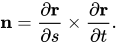
If a surface 
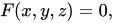


For a surface 




Orientation
The normal to a (hyper)surface is usually scaled to have unit length, but it does not have a unique direction, since its opposite is also a unit normal. For a surface which is the topological boundary of a set in three dimensions, one can distinguish between two normal orientations, the inward-pointing normal and outer-pointing normal. For an oriented surface, the normal is usually determined by the right-hand rule or its analog in higher dimensions.
If the normal is constructed as the cross product of tangent vectors (as described in the text above), it is a pseudovector.
Transforming normals
When applying a transform to a surface it is often useful to derive normals for the resulting surface from the original normals.
Specifically, given a 3×3 transformation matrix 


Write n′ as 

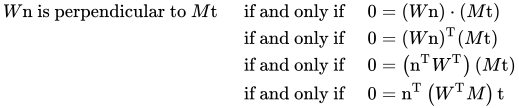
Choosing 
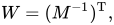


Therefore, one should use the inverse transpose of the linear transformation when transforming surface normals. The inverse transpose is equal to the original matrix if the matrix is orthonormal, that is, purely rotational with no scaling or shearing.

04Hypersurfaces in n-dimensional space
For an 







The definition of a normal to a surface in three-dimensional space can be extended to 



The normal line is the one-dimensional subspace with basis

A vector that is normal to the space spanned by the linearly independent vectors v1, ..., vr−1 and falls within the r-dimensional space spanned by the linearly independent vectors v1, ..., vr is given by the r-th column of the matrix Λ = V(VTV)−1, where the matrix V = (v1, ..., vr) is the juxtaposition of the r column vectors. (Proof: Λ is V times a matrix so each column of Λ is a linear combination of the columns of V. Furthermore, VTΛ = I, so each column of V other than the last is perpendicular to the last column of Λ.) This formula works even when r is less than the dimension of the Euclidean space n. The formula simplifies to Λ = (VT)−1 when r = n.
05Varieties defined by implicit equations in n-dimensional space
A differential variety defined by implicit equations in the 


In other words, a variety is defined as the intersection of 
The normal (affine) space at a point
These definitions may be extended verbatim to the points where the variety is not a manifold.
Example
Let V be the variety defined in the 3-dimensional space by the equations



At a point 


At the point 


06Uses
- Surface normals are useful in defining surface integrals of vector fields.
- Surface normals are commonly used in 3D computer graphics for lighting calculations (see Lambert's cosine law), often adjusted by normal mapping.
- Render layers containing surface normal information may be used in digital compositing to change the apparent lighting of rendered elements.
- In computer vision, the shapes of 3D objects are estimated from surface normals using photometric stereo.
- The normal vector may be obtained as the gradient of the signed distance function.

07Normal in geometric optics
The normal ray is the outward-pointing ray perpendicular to the surface of an optical medium at a given point. In reflection of light, the angle of incidence and the angle of reflection are respectively the angle between the normal and the incident ray (on the plane of incidence) and the angle between the normal and the reflected ray.
Sources and credits
This article is adapted from the Wikipedia article “Normal (geometry)”, written by its contributors and licensed under CC BY-SA 4.0. Fathomly has changed the layout, removed citation markers, navigation and maintenance notices, and adjusted punctuation. This adapted version is shared under the same license. For references, see the original article.
Images, from Wikimedia Commons:
- Normal vectors2.svg by Unknown author, Public domain
- Surface normal illustration.svg by Patrick87, Public domain
- Tangent and normal to a curve.svg by TealComet, CC0
- Plane equation qtl3.svg by Quartl, CC BY-SA 3.0
- Normal vectors on a curved surface.svg by Chetvorno, CC0
- Surface normals.svg by Nicoguaro, CC BY 4.0
Fathomly is not affiliated with or endorsed by the Wikimedia Foundation. Spotted a problem? Tell us.