Polydivisible number
Number whose first n digits is a multiple of n
In mathematics a polydivisible number (or magic number) is a number in a given number base with digits abcde... that has the following properties:
- Its first digit a is not 0.
- The number formed by its first two digits ab is a multiple of 2.
- The number formed by its first three digits abc is a multiple of 3.
- The number formed by its first four digits abcd is a multiple of 4.
- etc.
01Definition
Let 


.
- Example
For example, 10801 is a seven-digit polydivisible number in base 4, as








02Enumeration
For any given base 
Maximum polydivisible number
The following table lists maximum polydivisible numbers for some bases b, where A−Z represent digit values 10 to 35.
| Base |
Maximum polydivisible number (OEIS: A109032) | Number of base-b digits (OEIS: A109783) |
|---|---|---|
| 2 | 102 | 2 |
| 3 | 20 02203 | 6 |
| 4 | 222 03014 | 7 |
| 5 | 40220 422005 | 10 |
| 10 | 36085 28850 36840 07860 36725 | 25 |
| 12 | 6068 903468 50BA68 00B036 20646412 | 28 |
Estimate for Fb(n) and Σ(b)
Let 

If 


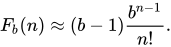
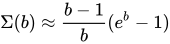
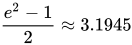
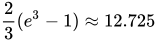
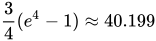
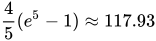
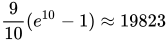
Summing over all values of n, this estimate suggests that the total number of polydivisible numbers will be approximately
03Specific bases
All numbers are represented in base
Base 2
| Length n | F2(n) | Est. of F2(n) | Polydivisible numbers |
|---|---|---|---|
| 1 | 1 | 1 | 1 |
| 2 | 1 | 1 | 10 |
| 3 | 0 | 1 |  |
Base 3
| Length n | F3(n) | Est. of F3(n) | Polydivisible numbers |
|---|---|---|---|
| 1 | 2 | 2 | 1, 2 |
| 2 | 3 | 3 | 11, 20, 22 |
| 3 | 3 | 3 | 110, 200, 220 |
| 4 | 3 | 2 | 1100, 2002, 2200 |
| 5 | 2 | 1 | 11002, 20022 |
| 6 | 2 | 1 | 110020, 200220 |
| 7 | 0 | 0 | |
Base 4
| Length n | F4(n) | Est. of F4(n) | Polydivisible numbers |
|---|---|---|---|
| 1 | 3 | 3 | 1, 2, 3 |
| 2 | 6 | 6 | 10, 12, 20, 22, 30, 32 |
| 3 | 8 | 8 | 102, 120, 123, 201, 222, 300, 303, 321 |
| 4 | 8 | 8 | 1020, 1200, 1230, 2010, 2220, 3000, 3030, 3210 |
| 5 | 7 | 6 | 10202, 12001, 12303, 20102, 22203, 30002, 32103 |
| 6 | 4 | 4 | 120012, 123030, 222030, 321030 |
| 7 | 1 | 2 | 2220301 |
| 8 | 0 | 1 | |
Base 5
The polydivisible numbers in base 5 are
- 1, 2, 3, 4, 11, 13, 20, 22, 24, 31, 33, 40, 42, 44, 110, 113, 132, 201, 204, 220, 223, 242, 311, 314, 330, 333, 402, 421, 424, 440, 443, 1102, 1133, 1322, 2011, 2042, 2200, 2204, 2231, 2420, 2424, 3113, 3140, 3144, 3302, 3333, 4022, 4211, 4242, 4400, 4404, 4431, 11020, 11330, 13220, 20110, 20420, 22000, 22040, 22310, 24200, 24240, 31130, 31400, 31440, 33020, 33330, 40220, 42110, 42420, 44000, 44040, 44310, 110204, 113300, 132204, 201102, 204204, 220000, 220402, 223102, 242000, 242402, 311300, 314000, 314402, 330204, 333300, 402204, 421102, 424204, 440000, 440402, 443102, 1133000, 1322043, 2011021, 2042040, 2204020, 2420003, 2424024, 3113002, 3140000, 3144021, 4022042, 4211020, 4431024, 11330000, 13220431, 20110211, 20420404, 24200031, 31400004, 31440211, 40220422, 42110202, 44310242, 132204314, 201102110, 242000311, 314000044, 402204220, 443102421, 1322043140, 2011021100, 3140000440, 4022042200
The smallest base 5 polydivisible numbers with n digits are
- 1, 11, 110, 1102, 11020, 110204, 1133000, 11330000, 132204314, 1322043140, none...
The largest base 5 polydivisible numbers with n digits are
- 4, 44, 443, 4431, 44310, 443102, 4431024, 44310242, 443102421, 4022042200, none...
The number of base 5 polydivisible numbers with n digits are
- 4, 10, 17, 21, 21, 21, 13, 10, 6, 4, 0, 0, 0...
| Length n | F5(n) | Est. of F5(n) |
|---|---|---|
| 1 | 4 | 4 |
| 2 | 10 | 10 |
| 3 | 17 | 17 |
| 4 | 21 | 21 |
| 5 | 21 | 21 |
| 6 | 21 | 17 |
| 7 | 13 | 12 |
| 8 | 10 | 8 |
| 9 | 6 | 4 |
| 10 | 4 | 2 |
Base 10
The polydivisible numbers in base 10 are
- 1, 2, 3, 4, 5, 6, 7, 8, 9, 10, 12, 14, 16, 18, 20, 22, 24, 26, 28, 30, 32, 34, 36, 38, 40, 42, 44, 46, 48, 50, 52, 54, 56, 58, 60, 62, 64, 66, 68, 70, 72, 74, 76, 78, 80, 82, 84, 86, 88, 90, 92, 94, 96, 98, 102, 105, 108, 120, 123, 126, 129, 141, 144, 147, 162, 165, 168, 180, 183, 186, 189, 201, 204, 207, 222, 225, 228, 243, 246, 249, 261, 264, 267, 282, 285, 288... (sequence A144688 in the OEIS)
The smallest base 10 polydivisible numbers with n digits are
- 1, 10, 102, 1020, 10200, 102000, 1020005, 10200056, 102000564, 1020005640, 10200056405, 102006162060, 1020061620604, 10200616206046, 102006162060465, 1020061620604656, 10200616206046568, 108054801036000018, 1080548010360000180, 10805480103600001800, ... (sequence A214437 in the OEIS)
The largest base 10 polydivisible numbers with n digits are
- 9, 98, 987, 9876, 98765, 987654, 9876545, 98765456, 987654564, 9876545640, 98765456405, 987606963096, 9876069630960, 98760696309604, 987606963096045, 9876062430364208, 98485872309636009, 984450645096105672, 9812523240364656789, 96685896604836004260, ... (sequence A225608 in the OEIS)
The number of base 10 polydivisible numbers with n digits are
- 9, 45, 150, 375, 750, 1200, 1713, 2227, 2492, 2492, 2225, 2041, 1575, 1132, 770, 571, 335, 180, 90, 44, 18, 12, 6, 3, 1, 0, 0, 0, 0, 0, 0, 0, 0, 0, 0, 0, 0, 0, 0, 0, 0, 0, 0, 0, 0, 0, 0, 0, 0, 0, ... (sequence A143671 in the OEIS)
| Length n | F10(n) | Est. of F10(n) |
|---|---|---|
| 1 | 9 | 9 |
| 2 | 45 | 45 |
| 3 | 150 | 150 |
| 4 | 375 | 375 |
| 5 | 750 | 750 |
| 6 | 1200 | 1250 |
| 7 | 1713 | 1786 |
| 8 | 2227 | 2232 |
| 9 | 2492 | 2480 |
| 10 | 2492 | 2480 |
| 11 | 2225 | 2255 |
| 12 | 2041 | 1879 |
| 13 | 1575 | 1445 |
| 14 | 1132 | 1032 |
| 15 | 770 | 688 |
| 16 | 571 | 430 |
| 17 | 335 | 253 |
| 18 | 180 | 141 |
| 19 | 90 | 74 |
| 20 | 44 | 37 |
| 21 | 18 | 17 |
| 22 | 12 | 8 |
| 23 | 6 | 3 |
| 24 | 3 | 1 |
| 25 | 1 | 1 |
04Programming example
The example below searches for polydivisible numbers in Python.
def find_polydivisible(base: int) -> list[int]: """Find polydivisible number.""" numbers = [] previous = [i for i in range(1, base)] new = [] digits = 2 while not previous == []: numbers.append(previous) for n in previous: for j in range(0, base): number = n * base + j if number % digits == 0: new.append(number) previous = new new = [] digits = digits + 1 return numbersSources and credits
This article is adapted from the Wikipedia article “Polydivisible number”, written by its contributors and licensed under CC BY-SA 4.0. Fathomly has changed the layout, removed citation markers, navigation and maintenance notices, and adjusted punctuation. This adapted version is shared under the same license. For references, see the original article.
Images, from Wikimedia Commons:
- Graph of polydivisible number vectorial.svg by Guillaume Jacquenot, CC BY-SA 3.0
Fathomly is not affiliated with or endorsed by the Wikimedia Foundation. Spotted a problem? Tell us.